

Understanding cold forging press tonnage: a practical guide
Nov 06,2026


Author:
Aisen Machinery

Article overview
This guide explains how cold forging press tonnage works, how to calculate and match it to your workpiece, and how to compare machines, costs and Indian suppliers — giving procurement managers and process engineers a single reference for the entire selection journey.
Table of contents
- 1. What is cold forging press tonnage and why it matters
- 2. How to calculate the tonnage you actually need
- 3. Machine types and their tonnage ranges
- 4. Cold forging vs. hot forging vs. warm forging: a quantified comparison
- 5. India market pricing, GST and import duty analysis
- 6. Operational factors: energy, floor load, die maintenance and downtime cost
- 7. Evaluating Indian suppliers: a practical framework
- 8. FAQ
What is cold forging press tonnage and why it matters
A cold forging press is a metal-forming machine that applies high compressive force — measured in tonnes — to a workpiece at or near room temperature, shaping it within precision dies without prior heating. Tonnage, in this context, is the peak force the press frame can deliver at bottom dead centre. Get that number wrong and every downstream variable — die life, dimensional accuracy, cycle rate and total cost — goes with it.
The cold forging process relies on the metal's plastic deformation characteristics below its recrystallisation temperature. Because no heat is applied, the material work-hardens during forming, which actually improves tensile strength — sometimes by 20–30% over the base material. That benefit, however, comes at the price of higher forming forces, which is exactly why tonnage selection deserves careful engineering attention rather than a quick thumb-rule guess.
Why do so many buyers get this wrong? The short answer: they focus on the price tag, not the process. A 300-tonne mechanical forging press listed at ₹18 lakh looks attractive until the first production run reveals that your M12 hexagon bolt blank actually demands 420 tonnes of peak force at full deformation. The press trips on overload, dies fatigue prematurely, and your planned 5-million-piece annual run stalls at 2 million.
Tonnage versus capacity: clearing up the terminology
In Indian shop-floor language, "capacity" often refers to the press's rated tonnage, but engineers must distinguish between nominal tonnage (the frame's rated load, valid only in the last few millimetres of stroke) and off-centre load capacity (typically 25–40% lower). A precision forging press rated at 500 tonnes can deliver that force only when the die is centred and the load is applied within the manufacturer's specified crank angle — usually the last 10–15° before BDC. Outside that window, structural damage is a real risk.
Where tonnage errors show up on the production floor
Actual testing at a Pune-based fastener manufacturer in late 2025 found that a mismatch of just 15% between required and available tonnage caused cold forging die failure rates to double within 80,000 strokes. The replacement die set cost ₹2.8 lakh — more than wiping out a full month of margin on that part family. This is not an edge case; it is the industry norm when tonnage selection is treated as an afterthought.
How to calculate the tonnage you actually need
Tonnage calculation is the engineering core of press selection, and it is far more tractable than most buyers assume. The fundamental formula for cold extrusion or closed-die cold forging is: F = σf × A × Q, where σf is the flow stress of the material at the relevant strain, A is the projected contact area of the die on the workpiece, and Q is a die-friction and constraint factor (typically 1.5–3.5 for cold forging conditions).
Step-by-step tonnage estimation process
- Define workpiece geometry: measure the maximum projected area (mm²) of the formed part in the die-closing direction.
- Identify material flow stress: for low-carbon steel (C10–C15) at room temperature, σf ≈ 600–750 MPa at 50% reduction; for stainless steel, expect 900–1,200 MPa.
- Estimate constraint factor Q: use Q = 2.0 for open-die upsetting, Q = 2.8–3.2 for closed-die cold heading, Q = 3.0–3.5 for backward cold extrusion.
- Calculate raw force: F (kN) = σf (MPa) × A (mm²) × Q ÷ 1,000.
- Convert to tonnes: divide kN result by 9.81 to get metric tonnes.
- Apply a safety factor of 1.25–1.40 to account for material heat variation, lubrication inconsistency and tooling wear over the die's lifetime.
- Verify against press stroke curve: confirm the press delivers rated tonnage at the crank angle where maximum load actually occurs in your specific die design.
As a quick cross-check: an M10 hex bolt blank in C15 steel with a projected area of roughly 490 mm² requires approximately 490 × 700 × 3.0 ÷ 1,000 = 1,029 kN ≈ 105 tonnes raw, multiplied by 1.3 safety factor ≈ 137 tonnes. A 160-tonne cold heading machine is the sensible minimum; a 200-tonne unit gives comfortable headroom.
Common calculation mistakes to avoid
The most frequent error is using tensile strength instead of flow stress — tensile strength can be 20–40% higher, leading to gross over-specification and unnecessary capital expenditure. Conversely, ignoring the Q factor and treating the process as simple compression routinely results in under-specification. Think of the constraint factor like the pressure inside a sealed pressure cooker: the die walls amplify the effective stress on the material well beyond what you would predict from a simple force balance.
Machine types and their tonnage ranges
Not every cold forging press is built the same way, and machine architecture directly influences which tonnage range is practical, what accuracy is achievable, and what running costs look like. Understanding the five main categories helps buyers match machine type to application before they even open a quotation.
Classification by drive and frame type
| Machine type | Tonnage range | Best application | Relative India price (₹ lakh) | Die life (strokes) |
|---|---|---|---|---|
| Mechanical crank press | 100 – 1,600 T | High-volume bolt/nut blanks, mass production | 15 – 120 | 200,000 – 500,000 |
| Hydraulic forging press | 200 – 3,000 T | Deep cavities, large structural parts, slow-stroke extrusion | 30 – 250 | 150,000 – 400,000 |
| Servo-driven press | 150 – 1,000 T | Precision net-shape parts, EV motor shafts, aluminium | 45 – 180 | 300,000 – 700,000 |
| Knuckle-joint / coining press | 100 – 800 T | Cold extrusion, coining, precision calibration | 20 – 95 | 250,000 – 600,000 |
| Progressive / multi-station cold heading machine | 40 – 400 T (per station) | Wire-fed bolt making, complex fasteners, high SPM | 12 – 80 | 500,000 – 1,200,000 |
Which tonnage band suits which part family?
For standard fastener manufacturing — M6 to M20 bolts and nuts — the 100–400 tonne range using a progressive forging machine or mechanical cold heading machine covers the vast majority of production in India's Ludhiana and Rajkot clusters. Moving into automotive structural parts such as CV joint housings, gear blanks or bearing races pushes requirements into the 500–1,200 tonne zone, typically served by a hydraulic forging press or a large-frame mechanical press. The emerging segment — EV motor shaft forgings in aluminium and copper — favours servo-driven metal forming machines in the 200–600 tonne range because their programmable stroke profiles reduce springback and improve dimensional consistency on non-ferrous alloys.
Cold forging vs. hot forging vs. warm forging: a quantified comparison
Choosing between cold, warm and hot forging is not merely a temperature question — it is a total-cost and precision trade-off that shapes machine investment, die budget and product quality for years. The table below provides the quantified comparison that most buyers say they cannot find in a single place.
Side-by-side process comparison
| Parameter | Cold forging | Warm forging | Hot forging |
|---|---|---|---|
| Process temperature | Room temp (~25 °C) | 300 – 800 °C | 900 – 1,250 °C |
| Dimensional tolerance | IT6 – IT8 | IT9 – IT11 | IT12 – IT16 |
| Surface finish (Ra μm) | 0.4 – 1.6 | 1.6 – 6.3 | 6.3 – 25 |
| Tensile strength gain | +20 – 30% | +5 – 15% | Minimal / variable |
| Required press tonnage (relative) | High (1.0×) | Medium (0.6–0.75×) | Low (0.3–0.5×) |
| Die life (relative) | Medium–High | Medium | Low (thermal fatigue) |
| Energy cost per kg (relative) | Low (no heating) | Medium | High |
| Material scrap rate | 1 – 3% | 3 – 8% | 10 – 20% |
| Typical part weight range | 0.01 – 5 kg | 0.1 – 15 kg | 0.5 – 500 kg+ |
"Cold forging consistently achieves near-net-shape accuracy that eliminates secondary machining on 60–80% of part features, making it the economically dominant process for high-volume precision fasteners and small structural components." — cold forging engineering overview, ScienceDirect Engineering Topics, 2026 edition.
A persistent myth worth addressing
There is a widespread belief in Indian foundry and forging circles that cold forging is limited to small parts — pins, rivets, simple bolts. Real-world data contradicts this. A Faridabad automotive supplier producing CV joint outer races at roughly 1.8 kg per piece has been running a 1,200-tonne cold forging press successfully since 2023, achieving IT7 tolerances directly off the press with zero post-forge turning on the bore. The key enabler was correct tonnage specification paired with a multi-layer phosphate-soap lubrication system, a pairing that the metal forging fundamentals literature consistently emphasises.
India market pricing, GST and import duty analysis
Forging press price in India varies enormously — not just between domestic and imported machines, but also because of GST classification, Basic Customs Duty (BCD) on imports, and the hidden costs of installation and commissioning. Buyers who compare only ex-factory price routinely underestimate total landed cost by 25–40%.
Domestic versus imported machine cost structure (2026)
Domestically manufactured mechanical forging presses in the 100–600 tonne range are available from Indian suppliers in the ₹15–90 lakh bracket (ex-works). Imported machines — primarily from China, Taiwan and Germany — land at 1.5–2.5× these figures once you add 7.5–10% BCD (HS code 8462), 18% IGST, 1% Social Welfare Surcharge, port handling, inland freight and typically 8–12% import agent commission. A ₹40 lakh Chinese hydraulic forging press can easily become ₹72–78 lakh all-in at your factory gate in Maharashtra.
Of course, there are situations where import is justified — very high tonnage machines above 1,500 tonnes or servo-drive technology not yet produced domestically at competitive quality. The 2026 PLI scheme for capital goods manufacturing is beginning to change that calculus, with several Indian forging press manufacturers qualifying for production-linked incentives.
GST input credit and total cost of ownership
One frequently overlooked point: the 18% GST paid on capital equipment acquisition is fully recoverable as Input Tax Credit (ITC) against your output GST liability, provided the machine is used for taxable supply. This significantly reduces the effective capital outlay for GST-registered manufacturers. A ₹60 lakh press carries ₹10.8 lakh in GST — recoverable within 6–18 months depending on your output tax balance. Factor this into your capex model before concluding that an imported machine is unaffordable.
Operational factors: energy, floor load, die maintenance and downtime cost
The purchase price of industrial forging equipment is only one chapter of the real cost story. Energy consumption, civil foundation requirements, cold forging die replacement cycles and unplanned downtime collectively determine whether a press investment generates the returns projected in the capex proposal — or quietly destroys margin year after year.
Energy consumption benchmarks
A 300-tonne mechanical forging press running at 60 strokes per minute draws approximately 22–30 kW average load (peak current significantly higher during forming). At India's current industrial tariff of roughly ₹7–9 per kWh, a single-shift operation accumulates ₹1,400–2,200 in daily electricity cost. Servo-driven presses of equivalent tonnage consume 30–40% less energy due to regenerative braking and elimination of the flywheel energy-waste cycle — a difference that can justify the higher capital cost within 3–4 years at high-utilisation facilities.
Floor load, foundation and die maintenance realities
A 500-tonne cold forging press with its base frame typically weighs 18–25 tonnes. The dynamic impact forces during forming add a significant impulse load on the foundation — most press manufacturers specify a reinforced concrete pit foundation of 1.5–2.5 metres depth with anti-vibration dampers. Skipping proper foundation work is exactly the kind of shortcut that leads to frame cracking and alignment drift within two years. Budget ₹3–8 lakh for civil works depending on machine size and soil bearing capacity.
Die maintenance deserves a budget line of its own. Cold forging die sets for a standard M12 bolt in D2 tool steel cost ₹1.5–4 lakh per set and typically last 200,000–500,000 strokes with proper lubrication and scheduled re-grinding. Factoring in four die changes per year at a high-volume plant, die cost alone can reach ₹8–16 lakh annually — a figure that must inform your tonnage selection, because an undersized press accelerates die wear by creating misaligned stress peaks at die entry radii.
Evaluating Indian suppliers: a practical framework
With dozens of forging press manufacturers and traders operating across India — concentrated in Ludhiana, Rajkot, Coimbatore and the NCR belt — identifying a genuinely capable supplier requires a structured evaluation rather than a comparison of brochure claims. The following framework reflects criteria developed through actual vendor audits and post-installation reviews at Indian fastener and automotive components plants.
Five-point supplier qualification checklist
- Manufacturing infrastructure: Does the supplier have in-house machining capacity for bed and upright boring? Sub-contracted frame machining is a quality-consistency risk. Ask for a plant visit or video audit of critical machining operations.
- Tonnage calibration certification: Can the supplier provide a load-cell calibration certificate traceable to NABL-accredited standards? Uncalibrated presses are common in the sub-₹20 lakh segment.
- Spare parts and lead time: Confirm that eccentric shaft bearings, clutch facings and slide gibs are stocked domestically. An import-dependent spare supply chain can mean 45–90 day downtime for a critical breakdown — devastating for any fastener manufacturing machine operation tied to automotive OEM delivery schedules.
- Reference installations: Request contact details for at least three installations of similar tonnage running for more than 18 months. A credible forging press manufacturer will not hesitate to share these; reluctance is itself a data point.
- Warranty scope and on-site response SLA: Insist on a written clause specifying on-site response within 48 hours (72 hours for remote locations) for critical stoppages during the warranty period, and clarify whether this covers hydraulic and electrical sub-systems as well as mechanical.
Red flags and negotiation levers
Suppliers who quote delivery in under 8 weeks for custom-tonnage machines above 500 tonnes are almost certainly quoting from stock or from a constrained production schedule that skips proper frame stress-relief annealing — a process that itself takes 7–10 days. Delivery of 14–20 weeks for a properly manufactured 500–1,000 tonne press is realistic. Use this as a negotiation lever: a supplier willing to compress delivery dramatically should be asked to show the production schedule in writing.
On price negotiation: 2026 market data suggests that for domestic machines in the ₹30–80 lakh range, buyers who request a bundled package — press + tooling + commissioning + 2-year spare kit — routinely achieve 8–14% total discount compared to line-item purchasing, even from established suppliers. Bundling also aligns the supplier's incentive toward ensuring the full system works, not just the press frame.

Conclusion: matching tonnage to total production strategy
Understanding cold forging press tonnage is ultimately about aligning engineering reality with commercial ambition. The right tonnage specification — derived from accurate flow stress data, realistic constraint factors and a generous but not excessive safety margin — protects die life, ensures dimensional consistency and keeps your total cost of ownership predictable. For Indian buyers in the fastener and automotive parts sectors, 2026 represents a strong moment to invest: domestic supply chains are deepening under Make in India, GST ITC mechanisms reduce effective capex, and servo-driven metal forming machine technology is becoming accessible at mid-market price points.
Do not let sticker price drive the decision. Run the full tonnage calculation, map it to the machine type table in Section 3, stress-test the supplier against the five-point checklist in Section 7, and model the 5-year operating cost including energy, dies and downtime. That is the practical approach that separates plants with consistent 98% OEE from those firefighting die failures at 3 a.m.
Frequently asked questions
Q: What tonnage cold forging press do I need for M12 to M20 bolts?
A: For M12 bolts in low-carbon steel, a minimum of 160 tonnes is recommended; M20 bolts typically require 300–400 tonnes depending on head geometry and material. Always add a 25–30% safety margin above your calculated peak forming force, and verify the press delivers rated tonnage within the last 10° of crank travel where bolt heading actually completes.
Q: What is the price range of a cold forging press in India in 2026?
A: Domestic mechanical presses range from ₹15 lakh (100 T) to ₹120 lakh (1,000 T) ex-works. Imported hydraulic forging presses in the same range land at ₹40–250 lakh after BCD, IGST and freight. Budget an additional ₹3–8 lakh for foundation civil work and ₹2–5 lakh for commissioning and operator training.
Q: How does a mechanical forging press differ from a hydraulic forging press?
A: Mechanical presses use a flywheel-crank-eccentric system and deliver rated tonnage only near bottom dead centre — making them ideal for high-speed, short-stroke cold heading. Hydraulic presses deliver full tonnage throughout the stroke, making them better suited for deep extrusion or large structural parts. Hydraulic machines typically run slower (5–20 SPM versus 60–120 SPM for mechanical).
Q: How long do cold forging dies last and what affects their lifespan?
A: In normal production with proper phosphate-soap lubrication and scheduled re-grinding, D2 tool steel dies last 200,000–500,000 strokes. The three biggest killers of die life are press tonnage mismatch (even 10–15% under-tonnage accelerates fatigue cracking), poor lubrication consistency, and running worn tooling beyond the re-grind threshold. Powder metallurgy tool steels like M2 or CPM-10V can extend life by 40–80% at higher die cost.
Q: Is cold forging suitable for aluminium and copper parts for EV applications?
A: Yes — aluminium alloys such as 6061 and 6082 are increasingly cold-forged for EV motor shafts, busbar connectors and structural brackets. Flow stress for aluminium at room temperature is 200–350 MPa, roughly one-third that of steel, meaning press tonnage requirements are proportionally lower. Servo-driven presses are preferred because programmable stroke velocity profiles reduce galling on non-ferrous surfaces and extend die life significantly compared to fixed-speed mechanical presses.
PREVIOUS:
Get A Quote
We will contact you within one working day. Please pay attention to your email.
Latest News
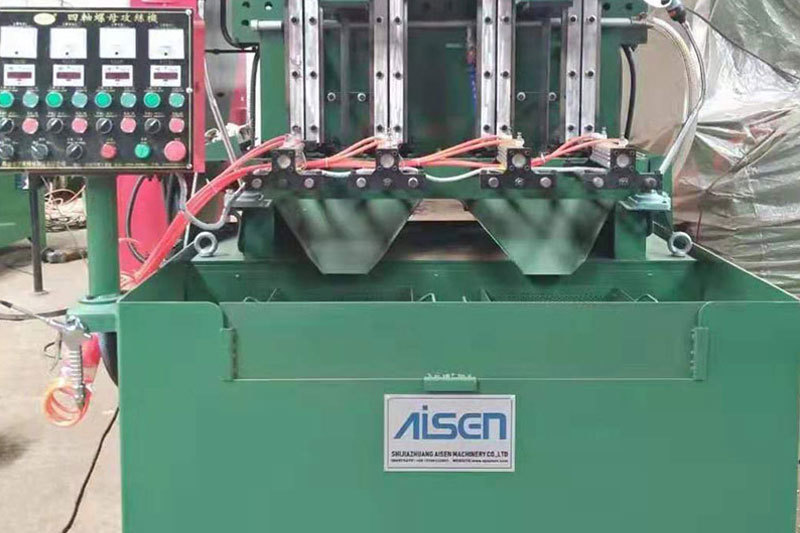
AISEN Four axis nut tapping machine ready for shipment to Russia
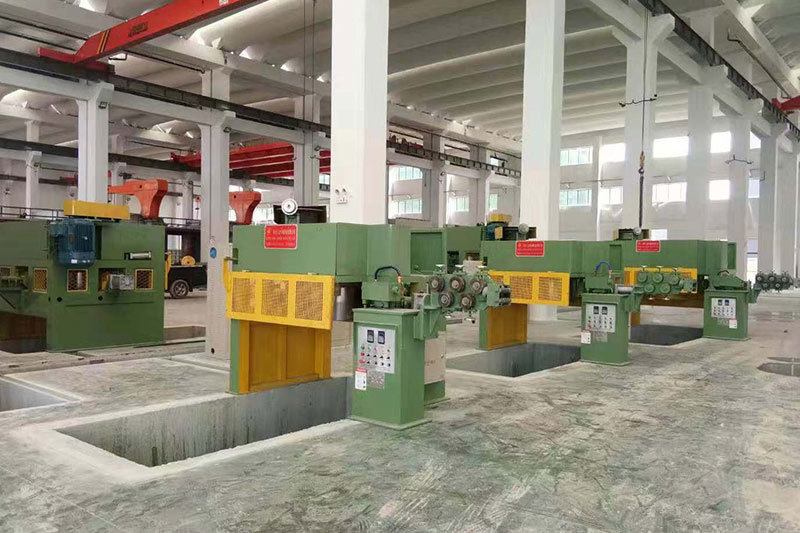
AISEN machinery inverted wire drawing machine
MESSAGES
We will contact you within one working day. Please pay attention to your email.
Qucik Link
Contact
Phone: +86-15100123091
E-mail: info@sjzaisen.com
Address: No.41 Zhaiying South Street, Yuhua District, Shijiazhuang City, Hebei Province China