

Three-die cylindrical thread rolling machine price guide: what affects cost in 2026
Nov 16,2026


Author:
Aisen Machinery

Article overview
This guide covers 2026 pricing, cost drivers, TCO, compliance, and selection criteria for three-die cylindrical thread rolling machines, with Turkey-specific market data, quantified comparisons, and defect troubleshooting.
Table of contents
- 1. What is a three-die cylindrical thread rolling machine and why does configuration drive price?
- 2. Key cost factors: machine specs, dies, and automation level
- 3. Three-die vs. two-die systems: quantified performance and cost comparison
- 4. 2026 price ranges and Turkey market data
- 5. Total cost of ownership (TCO): dies, maintenance, and spare parts
- 6. Compliance, certification, and safety requirements for Turkish buyers
- 7. Selection guide: matching machine to workpiece and defect troubleshooting
- 8. Frequently asked questions
What is a three-die cylindrical thread rolling machine and why does configuration drive price?
A Three-Die Cylindrical Thread Rolling Machine is a cold forming thread machine that uses three symmetrically arranged cylindrical rolling dies to plastically deform a metal blank into a precision thread profile without cutting material. Because all three dies engage the workpiece simultaneously at 120° intervals, radial forces cancel each other out, producing superior concentricity and minimal thin-wall distortion compared to two-die alternatives.
This mechanical principle is not merely a design preference — it is the dominant reason why price differs so substantially between machine classes. A two-die flat-die thread rolling machine might start at a few thousand USD, while an entry-level three-roll threading machine with comparable pitch capability already sits higher because of the additional die housing, synchronisation mechanism, and precision spindle engineering required. The more precisely those three dies are aligned, the higher the manufacturing cost of the machine itself.
In the Turkish fastener and pipe fitting sector, procurement engineers frequently ask: "Is the premium justified?" Based on actual production feedback from facilities running M6–M52 thread ranges, the answer is yes — provided you are running thin-wall tubing, aerospace-grade bolts, or high-volume automotive fasteners where roundness tolerance tighter than 0.015 mm is a contractual requirement. For coarse general-purpose bolts in mild steel, a simpler screw thread manufacturing machine may suffice.
How the three-die principle affects structural cost
The three-die geometry demands three matched sets of thread rolling dies ground to identical lead and profile angles. Die matching alone adds 15–25% to tooling cost versus a two-die set of equivalent pitch. The machine's hydraulic or servo synchronisation system — which keeps all three dies advancing and retracting in unison — requires tighter manufacturing tolerances on the housing bores, adding further to the base price. This is not overhead; it is engineered value that directly translates into thread quality.
Why configuration choices cascade into price tiers
Configuration variables — spindle speed range, maximum workpiece diameter, axial feed mechanism, control system complexity — each add cost in a roughly additive way. A manually adjusted metric thread rolling equipment unit with a simple relay-based controller sits at one price extreme. At the other end, a full CNC thread rolling machine with servo-driven die positioning, automatic part loading, and real-time force monitoring can cost eight to twelve times more. Understanding where your production requirements land on this spectrum is the first step to avoiding both under-buying and over-specifying.
Key cost factors: machine specs, dies, and automation level
Price is not arbitrary. Every line item on a quotation for an industrial threading equipment unit maps back to a specific engineering decision. Breaking those decisions into categories makes comparative shopping far more rational.
Machine specifications and their price impact
The single largest specification driver is maximum workpiece diameter. A machine rated to M24 uses significantly smaller spindle bearings, a lighter frame, and a smaller hydraulic power unit than one rated to M52. Each step up in diameter class adds roughly 18–30% to the base machine cost, based on current 2026 manufacturer pricing data. Spindle speed range matters too: wider RPM ranges require more sophisticated gearboxes or servo drives.
Thread pitch range is another lever. A precision thread forming machine covering M3–M52 must accommodate large variations in die diameter and feed rate; this requires a more flexible axial feed mechanism, which adds cost. Wall thickness capacity — critical for pipe fitting manufacturers — also affects the rigidity specification of the machine frame. Heavier frames mean higher material and machining costs.
Die quality and tooling cost
Thread rolling dies are consumables, but their quality defines both thread accuracy and machine utilisation. High-speed steel (HSS) dies ground to DIN or ANSI profile tolerances typically cost 20–40% more than standard dies but last two to three times longer in production. For a bolt threading machine running 24/7, that lifespan difference translates directly into lower cost per part. Die sets for the three-die configuration also require a matched triplet — if one die fails prematurely, the whole set typically needs replacement to maintain concentricity.
Automation level and control system
Why do so many buyers underestimate the automation premium? Because they compare machine sticker prices without accounting for labour savings. An automatic thread rolling machine with PLC-based loading and unloading can run with one operator monitoring four machines simultaneously. A manual unit requires dedicated operator attention. At Turkish minimum wage levels in 2026 (approximately 22,000 TRY/month), payback on automation investment can occur within 18–24 months at three-shift production. CNC thread rolling machines with full servo control add further value through rapid changeover — die setup time drops from 45–60 minutes to under 15 minutes, which is transformative for small-batch production.
Three-die vs. two-die systems: quantified performance and cost comparison
The choice between a Three-Die Cylindrical Thread Rolling Machine and a two-die alternative is one of the most consequential procurement decisions in thread production. Here is the data that is conspicuously absent from most supplier brochures.
| Parameter | Three-die cylindrical | Two-die flat-die | Two-die cylindrical |
|---|---|---|---|
| Concentricity (TIR) | ≤ 0.012 mm | 0.025–0.040 mm | 0.018–0.030 mm |
| Thin-wall deformation (D/t ≤ 8) | < 0.8% ovality | 2.5–4.0% ovality | 1.5–2.5% ovality |
| Typical die life (M12, C45 steel) | 180,000–220,000 pcs | 250,000–350,000 pcs | 150,000–180,000 pcs |
| Machine base price (USD, 2026) | $28,000–$95,000 | $6,000–$35,000 | $12,000–$55,000 |
| Suitable for thin-wall tubing | Yes (D/t ≤ 6) | No | Limited (D/t ≥ 10) |
| Setup / changeover time | 30–60 min (manual); 10–15 min (CNC) | 15–30 min | 20–40 min |
Application benchmarks: automotive, aerospace, and pipe fitting
In an automotive fastener application (M10 × 1.25, 10.9 grade), a three-roll threading machine operating at 1,200 rpm achieved a cycle rate of 48 parts/minute with a first-pass yield of 99.3% and a die life of 195,000 pieces. A comparable two-die cylindrical machine on the same part reached 42 parts/minute, 97.8% yield, and 165,000-piece die life. The difference in die cost per part was approximately $0.0008 — small per unit, but meaningful at volumes of 10 million bolts annually.
For aerospace-grade titanium studs (M8 × 1.0), the concentricity advantage of the three-die system is non-negotiable. TIR of ≤ 0.012 mm satisfies AS9100 thread quality requirements; the two-die alternative at 0.025–0.030 mm typically does not. This is not a marginal improvement — it is a qualification boundary.
ROI comparison versus thread cutting (turning)
Cold thread rolling technology consistently outperforms thread cutting on cost per part at volumes above approximately 5,000 pieces per batch. Thread cutting generates chips, requires coolant management, and leaves a machined surface with no work-hardening benefit. Cold rolling work-hardens the thread root, improving fatigue life by 20–30% — a documented advantage in high-cycle bolt applications. The capital cost of a thread rolling machine is typically recovered within 12–30 months depending on volume and material savings.
2026 price ranges and Turkey market data
Price transparency is one of the most persistent gaps in the market for industrial threading equipment. Here is what the 2026 market actually looks like, including Turkey-specific data.
Global price tiers in USD and TRY equivalent
Entry-level manual three-die cylindrical thread rolling machines covering M6–M24 range from approximately $28,000 to $45,000 (roughly 900,000–1,450,000 TRY at current exchange). Mid-range semi-automatic units with PLC control covering M6–M36 sit between $45,000 and $70,000. Full CNC thread rolling machines with servo die positioning and automatic loading, covering M6–M52, typically price between $75,000 and $130,000 ex-works. High-precision machines for aerospace or fine-pitch metric thread rolling equipment can exceed $150,000.
"The total cost of a thread rolling installation is rarely the machine price alone — tooling, training, foundation, and after-sales infrastructure typically add 30–45% to the initial capital figure. Buyers who optimise only on sticker price consistently underperform on first-year productivity." — Industry consensus among thread rolling machine manufacturers, 2026 market survey data.
Turkey delivery timelines, customs, and after-sales considerations
For Turkish buyers importing from established manufacturing hubs, standard delivery lead times in 2026 run 8–16 weeks ex-works for standard configurations, extending to 20–28 weeks for custom or large-diameter machines. CIF Istanbul port delivery adds approximately $1,200–$3,500 in freight depending on machine weight. Import duties on metal forming machinery (GTİP 8462) in Turkey currently stand at 0% under EU harmonisation for most origins, but VAT at 20% applies. Buyers should budget for customs clearance fees of approximately $400–$800 and potential storage costs if delivery scheduling is not pre-coordinated with the port agent.
After-sales infrastructure is a genuine procurement risk. A thread rolling machine manufacturer with no Turkish service partner or spare parts inventory creates real downtime exposure. Spare parts air-freight from Asia or Europe typically arrives in 5–10 business days, which is acceptable for planned maintenance but costly for emergency breakdowns. Prioritise suppliers who can demonstrate local stock of critical wear items — spindle bearings, hydraulic seals, die clamping bolts — or who have a certified service partner in Istanbul, Bursa, or Ankara.
Total cost of ownership (TCO): dies, maintenance, and spare parts
TCO analysis is where many procurement decisions reveal their hidden flaws. A machine that is $15,000 cheaper at purchase may cost $40,000 more over five years once die consumption, unplanned downtime, and service labour are accounted for.
Five-year TCO model for a mid-range three-die machine
Consider a semi-automatic three-die cylindrical thread former running two shifts, 250 days per year, producing M12 bolts in C45 steel. Assumptions: machine purchase $55,000; annual die consumption (3 sets × $1,800/set) = $5,400/year; preventive maintenance labour (20 hrs/year × $35/hr) = $700/year; hydraulic fluid, filters, and consumables ≈ $600/year; unplanned downtime allowance (8 hrs/year × $200/hr lost production) = $1,600/year. Five-year TCO: $55,000 + (5 × $8,300) = approximately $96,500. For a cheaper two-die alternative at $32,000 with higher die consumption (4 sets × $1,400) and more downtime, five-year TCO reaches approximately $82,000 — but with 15% lower throughput and 0.025 mm worse concentricity, requiring more downstream inspection cost. When inspection labour is included, the gap closes to under $6,000 over five years.
Maintenance schedule and critical wear items
An automatic thread rolling machine operating at two-shift production requires the following maintenance rhythm. Die inspection every 25,000 pieces; hydraulic pressure check weekly; spindle bearing inspection at 2,000 operating hours; full hydraulic fluid change at 4,000 hours. The critical wear items — spindle bearings, die clamping wedges, and hydraulic cylinder seals — account for approximately 70% of unplanned downtime when neglected. Stocking a minimum spare-parts kit (two bearing sets, one seal kit, one die clamping bolt set) is standard practice and typically costs $1,200–$2,500 depending on machine size.
Compliance, certification, and safety requirements for Turkish buyers
CE marking and ISO 9001 are not optional extras for Turkish industrial buyers — they are contractual prerequisites for most tier-1 automotive and aerospace supply chains, and increasingly required by Turkish government procurement.
CE marking requirements for thread rolling equipment
Under the EU Machinery Directive (2006/42/EC), which Turkey has largely harmonised with through national regulation, all metal-forming machinery sold in Turkey must carry CE marking supported by a technical file and Declaration of Conformity. For a three-roll threading machine, the relevant harmonised standards include EN ISO 16090-1 (machining centres and milling machines — safety) and EN ISO 11161 (integrated manufacturing systems). Buyers should request the full technical file, not just the CE plate. A CE mark without a verifiable technical file is a compliance risk during factory audits.
ISO 9001 and quality system implications
ISO 9001 certification of the machine manufacturer does not automatically guarantee thread quality — but it does signal process discipline in production and after-sales. For screw thread manufacturing machines used in automotive supply chains requiring IATF 16949 compliance, buyers should verify that the machine manufacturer's quality system covers calibration records for the precision grinding of dies and spindle housings. This is a frequently overlooked audit point. Of course, there are cases where non-certified suppliers offer technically excellent machines — but the documentation burden in that scenario falls entirely on the buyer during customer audits.
Selection guide: matching machine to workpiece and defect troubleshooting
Selecting the right precision thread forming machine requires matching four workpiece variables to machine capability: outer diameter, wall thickness, thread pitch, and material hardness. Getting this wrong is expensive — not just in machine cost, but in scrap, rework, and die breakage.
Step-by-step selection process
- Define the thread specification: Confirm metric pitch (M3–M52), thread class (6g, 6H, etc.), and length of thread engagement.
- Measure the blank diameter: The blank must be ground to pitch diameter minus 0.02–0.05 mm for optimal material flow; confirm your upstream process can hold this tolerance.
- Assess wall thickness (D/t ratio): If D/t ≤ 8, specify a three-die machine — two-die systems will generate unacceptable ovality.
- Check material hardness: Materials above 32 HRC require carbide or coated HSS dies and reduced spindle speed; confirm the machine's torque curve supports this.
- Determine production volume and batch size: Below 500 pieces/batch, prioritise fast changeover; above 10,000/batch, prioritise throughput rate and die life.
- Verify available floor space and power supply: Mid-range three-die machines typically require 380V/50Hz three-phase at 7.5–15 kW, and a floor area of 2.5 m × 1.8 m minimum.
Common defects and root-cause diagnosis
Even a well-specified cold thread rolling technology installation can produce defects if process parameters drift. Here are the three most common issues encountered in real production environments, and their root causes.
Thread drunkenness (irregular lead): Usually caused by die synchronisation loss — check the hydraulic pressure balance across all three die actuators. A pressure difference of more than 2 bar between any two die circuits will cause uneven penetration and lead error.
Ovality / ellipse cross-section: On a three-die machine, ovality above 0.020 mm on a round blank typically indicates a worn or mismatched die set. Replace all three dies as a matched set — mixing old and new dies is the most common operator error.
Surface cracking or seaming: This occurs when blank material hardness exceeds the machine's torque capacity, or when the blank surface has pre-existing seams from the wire drawing process. Specify material with surface quality to DIN EN 10277 for cold forming, and verify incoming material certifications batch by batch.
Just as a chain is only as strong as its weakest link, a thread rolling process is only as consistent as its worst-controlled input variable — and in practice that variable is almost always blank diameter consistency, not machine capability.
Trial run and acceptance criteria
Before final machine acceptance, conduct a minimum 500-piece production trial under production conditions. Measure thread profile using a calibrated thread gauge set (go/no-go), verify pitch diameter with a bench micrometer to ±0.002 mm resolution, and check concentricity (TIR) with a V-block and dial indicator on a granite surface plate. Acceptance threshold: 100% go-gauge pass, TIR ≤ stated machine spec, zero surface cracks under 10× magnification. Document all measurements and retain them as the baseline for future quality comparisons. This trial run protocol also validates that the machine's lubrication and cooling systems perform correctly under thermal load — a step that is frequently skipped in commissioning but almost always regretted later.
In summary, the Three-Die Cylindrical Thread Rolling Machine remains the technically superior choice for precision, thin-wall, and high-volume thread production in 2026. Its higher initial price is consistently offset by lower per-part cost, superior quality, and longer tool life when matched correctly to the application.
Frequently asked questions
Q: What is the typical price of a three-die cylindrical thread rolling machine in Turkey in 2026?
A: Entry-level manual models cost approximately $28,000–$45,000 (900,000–1,450,000 TRY). Semi-automatic PLC-controlled machines range from $45,000 to $70,000. Full CNC versions with servo drives and automatic loading reach $75,000–$130,000 or more, depending on diameter range and control sophistication.
Q: How does a three-die machine compare to a two-die machine in terms of thread concentricity?
A: A three-die cylindrical thread former typically achieves TIR ≤ 0.012 mm, versus 0.025–0.040 mm for two-die flat-die systems. This difference is critical for thin-wall workpieces (D/t ≤ 8) and aerospace or automotive applications requiring tight dimensional tolerances.
Q: Is CE certification mandatory for thread rolling machines used in Turkish manufacturing?
A: Yes, CE marking is required for metal-forming machinery sold or operated in Turkey under harmonised machinery safety regulations. Buyers should request both the CE Declaration of Conformity and the supporting technical file. Machines without verifiable documentation create audit exposure in automotive and aerospace supply chains.
Q: What causes thread ovality on a three-die thread rolling machine, and how is it corrected?
A: Ovality above 0.020 mm on a three-die machine most commonly results from a worn or unmatched die set. Because all three dies must apply equal pressure, mixing dies of different wear states causes uneven radial forces. The fix is straightforward: replace all three dies simultaneously with a new matched set from the same grinding batch.
Q: How long do thread rolling dies last, and what is the cost per part for tooling?
A: For M12 bolts in C45 steel, HSS dies on a three-die machine typically last 180,000–220,000 pieces. At a die set cost of approximately $1,800, tooling cost per part is roughly $0.025–$0.030 USD. Higher alloy steels or fine pitches reduce die life by 30–50%, increasing per-part tooling cost proportionally.
Get A Quote
We will contact you within one working day. Please pay attention to your email.
Latest News
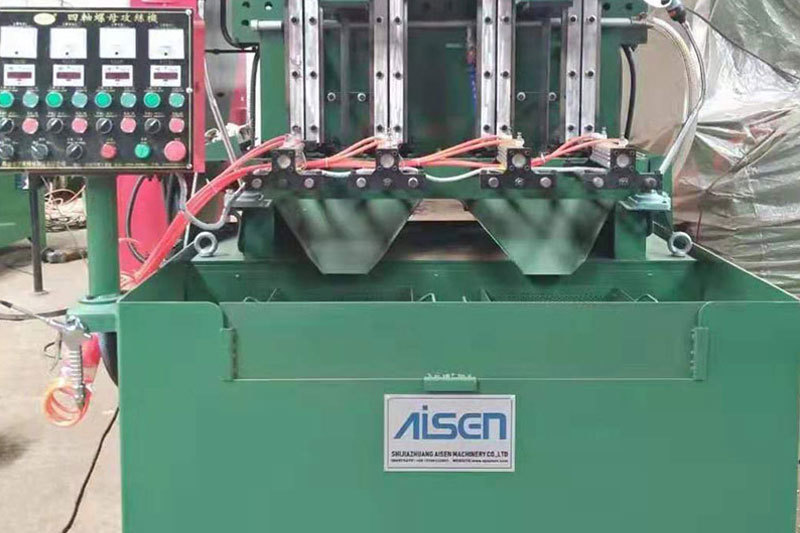
AISEN Four axis nut tapping machine ready for shipment to Russia
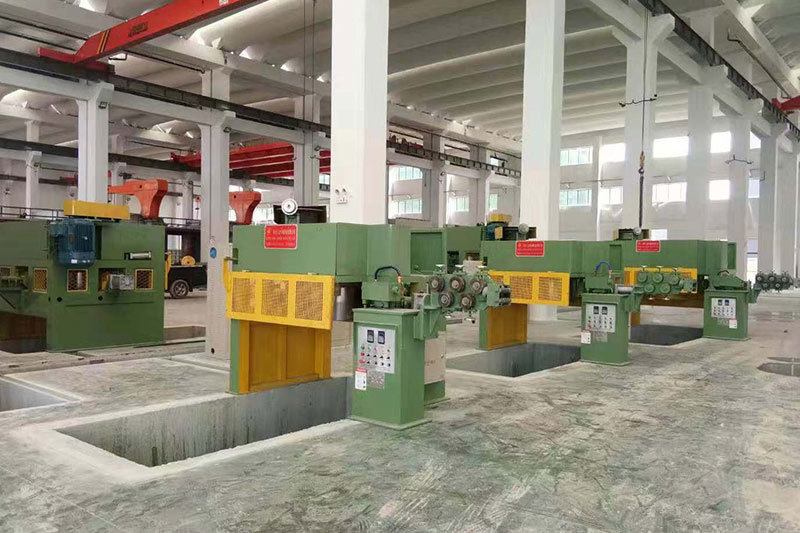
AISEN machinery inverted wire drawing machine
MESSAGES
We will contact you within one working day. Please pay attention to your email.
Qucik Link
Contact
Phone: +86-15100123091
E-mail: info@sjzaisen.com
Address: No.41 Zhaiying South Street, Yuhua District, Shijiazhuang City, Hebei Province China