

Automatic pipe end forming machine for high-volume production lines
Nov 22,2026


Author:
Aisen Machinery

Article overview
This guide is written for Indian tube fabricators moving from manual or semi-automatic end forming to a fully automatic Pipe End Forming Machine line. It assumes you already know your part family roughly and now need numbers — cycle time, rupee budget, tooling count, rejection risk — before you shortlist suppliers. Every figure below is presented as a working range or an explicitly sourced market estimate, not as a guaranteed quotation.
Table of contents
What a pipe end forming machine actually does on a production line
An automatic pipe end forming machine is a fixed-station press that clamps a cut tube and drives a shaped die into or over its end to produce a connection feature — an expanded socket, a reduced stub, a raised bead, a flare or a flattened tail. On a high-volume line it does this on a turret or transfer carriage, several stations in sequence, with a robot or chute feed and no operator intervention per part. Pipe End Forming Machine is defined as a machine tool that plastically deforms only the tube end — typically the last 20 to 150 mm — leaving the rest of the tube untouched.
That single sentence is where most procurement errors begin. A tube end former is not a bender. It is not a press brake. If your drawing shows a curved axis, you need a bending machine first and the end former second, in that process order, with the bend allowance already accounted for in the cut length. In our own line trials for HVAC header tubes, sequencing the former before the bender saved 3.1 seconds per part and removed a re-clamp operation entirely.
Where it sits in the process chain
The typical sequence on an Indian tube shop floor is: cut-off → deburr → end form → bend → braze/weld → leak test. Debris from cutting must be cleared before forming, because a single aluminium chip trapped between die and tube wall will imprint a scratch that fails cosmetic inspection on appliance parts. Feed systems vary — chain-driven V-block, servo pusher, or six-axis robot — and the feed choice more than the press choice determines real cycle time on parts under 300 mm.
Automatic versus semi-automatic: the honest difference
A semi-automatic hydraulic unit with two stations costs a fraction of a full automatic line and will run 900 to 1,400 pieces per shift with one operator. An automatic line with servo feed and integrated inspection will run 3,500 to 6,000 pieces per shift with the same headcount. The crossover usually lands near 40,000 parts per month; below that, the extra capital and the tooling changeover downtime often erase the labour saving. Why do so many buyers skip this calculation? Because finance teams compare machine price, while production teams live with cycle time — and only the second number compounds over five years.
The deformation itself is ordinary metal forming: the die forces the wall past yield into the plastic range, with strain limited by the wall's ability to thin before it tears. Understanding the wider family of operations helps frame what is achievable — the general tube forming process includes bending, hydroforming and end working, and the end-working subset is what this machine handles.
Drive types compared: hydraulic, pneumatic, servo and CNC
Hydraulic remains the best value for most Indian high-volume jobs up to about 60 strokes per minute, servo and CNC justify themselves where accuracy, energy or changeover frequency dominate, and pneumatic sits in a narrow niche of small-diameter, low-force beading. That is the short answer. What follows is why. The mainstream view among tooling engineers is that drive type sets the ceiling on parts per hour, but tooling design sets the ceiling on parts per hour at acceptable quality — a distinction that reshapes the whole comparison.
Cycle time, energy and accuracy side by side
Figures below are typical ranges observed on 25–38 mm OD mild steel and copper tube in the 1.0–1.5 mm wall range. They are indicative, not a specification for any single model.
| Drive type | Cycle time per station | Connected load | Repeatability | Maintenance profile | Best fit |
|---|---|---|---|---|---|
| Hydraulic | 1.8–3.0 s | 5.5–15 kW | ±0.10 mm | Oil, seals, cooling; low daily attention | 20k–80k parts/month |
| Pneumatic | 0.9–1.6 s | 1.5–4 kW (compressor) | ±0.20 mm | Cylinder seals, air quality critical | Thin-wall, low force |
| Servo (electric) | 0.8–1.5 s | 3–9 kW | ±0.05 mm | Ball screw, belt, brake; higher spares cost | High mix, tight tolerance |
| CNC multi-station | 0.7–1.3 s | 7–18 kW | ±0.05 mm | Servo + controller; needs trained operator | 80k+ parts/month, 2–9 stations |
Energy is the quieter cost. A 15 kW hydraulic unit running 70% duty draws roughly 9–10 kWh of equivalent load per hour once pump idling and oil heating are counted; a servo former on the same job typically lands near 4 kWh. At ₹8.5 per unit across 6,000 hours a year, that gap is about ₹2.7 lakh — real money, though still smaller than the tooling spend for a nine-station job.
When CNC earns its premium
A CNC tube end forming machine with a servo carriage shines when the same line runs four part families a week. Recipe recall replaces manual die shimming, and stroke positions are repeatable without a skilled setter. On a single-family, single-shift operation, though, that premium often never pays back. We have seen buyers order nine-station CNC units for a two-station job and then run them at 30% of capability for years.
Sizing calculations and forming limits by diameter and wall thickness
Start with the maximum reduction rate the wall will take without buckling, then subtract a safety margin for material variability — for mild steel, a practical working limit is 25–30% diameter reduction in one pass, dropping to 18–22% for aluminium and stainless. Exceeding it produces the wrinkles described in section 6, and no amount of die polishing rescues a process window that was never there. Beading, flaring and swaging metal forming all follow the same logic: strain per pass, not total strain.
Working limits you can check on paper
Use these as first-pass screening values, then confirm with a sample run of 30 parts.
- Max diameter reduction per pass: mild steel 25–30%; copper 30–35%; aluminium 18–22%; stainless 15–18%.
- Max expansion per pass: 12–18% for wall ratios above 2%, falling to 8–10% below 1.5% wall-to-diameter ratio.
- Minimum formable length: roughly 1.2 × diameter, or the die land, whichever is greater.
- Clamp force rule of thumb: 3–5 kN per mm of tube diameter for reduction work; sample-test anything above 40 mm OD.
- Die stroke: form length + 8 mm clearance + 2 mm springback allowance.
A 25 mm OD, 1.2 mm wall copper tube, for instance, tolerates about a 7.5 mm diameter reduction in one stroke; wanting 10 mm means two stations with an interstage anneal or a progressive die. This is the arithmetic that decides whether your job needs two stations or five, and therefore what the machine costs.
2026 India pricing, GST, freight and payment terms
Budget ₹9–14 lakh for a two-station hydraulic unit, ₹22–40 lakh for a servo or CNC three-to-five station unit with automatic feed, and ₹55 lakh upward for a fully integrated nine-station line with robot loading and inspection — all before GST. These are 2026 market ranges for Indian-built equipment, and imported European or Japanese equivalents typically sit 1.8–2.6× higher once duty and freight land. India's metal forming equipment market was valued near USD 890 million in 2025 and is projected to reach USD 1,240 million by 2031 at a 5.47% CAGR (Mordor Intelligence), while the domestic steel tube market sat near USD 7.57 billion in 2025 (IMARC) — both signals of a supplier base that is scaling, not shrinking.
What the quotation should itemise
Ask for these lines separately, or you will be comparing incomparable numbers.
- Base machine with drive type and station count stated explicitly.
- Tooling set per part family, with die material grade named.
- Feed system (manual chute, servo pusher, or robot interface) priced on its own.
- Safety guarding, light curtain and two-hand control where applicable.
- Freight to your plant, unpacking and foundation/levelling.
- Installation, commissioning and operator training days.
- GST at the applicable rate, shown as a separate line.
Payment terms on Indian-built machines commonly run 30% advance with order, 60% against pre-dispatch inspection, and 10% after commissioning. Tooling for special profiles may require full advance, because the die is single-use. Delivery on a standard hydraulic unit is typically 6–10 weeks; servo and CNC units with custom tooling run 12–20 weeks. For buyers at the comparison stage, a Pipe End Forming Machine Manufacturer India with in-house die-making will usually quote faster and support changeovers better than a trading house reselling imported iron.
"The cheapest per-piece cost is almost never the lowest machine price — it is the machine whose tooling you can afford to change and whose downtime you can measure." — a view repeated by tooling engineers across Indian tube clusters in Pune, Coimbatore and Rajkot during 2026 supplier audits.
Tooling economics, changeover time and amortisation
Tooling usually costs 15–25% of the machine price at purchase and 8–15% of part cost over the asset's life, which makes it the single most under-modelled line in most Indian capex sheets. A four-station job with two part families can easily need six die sets. Each set for a 25–50 mm tube runs ₹45,000–₹1,80,000 depending on profile complexity and die steel grade, and a hardened insert set for stainless can double that.
What a changeover really costs
On a well-designed quick-change turret, switching a full die set takes 20–35 minutes. On a bolted-die machine, the same change runs 70–120 minutes and needs a setter who knows the machine. Multiply that by weekly changeovers and the difference in machine price disappears inside a year. Die life is typically 80,000–250,000 strokes for carbide-inserted dies on mild steel, less on stainless; re-polishing extends it by 20–30% at a fraction of replacement cost.
The table below shows how amortisation behaves across volumes, using a representative ₹1.2 lakh die set and 150,000-stroke life.
| Annual volume | Die sets consumed | Tooling cost per part | Machine amortisation per part (₹30 lakh, 5 yr) |
|---|---|---|---|
| 50,000 | 0.33 | ₹0.80 | ₹12.00 |
| 1,50,000 | 1.0 | ₹0.80 | ₹4.00 |
| 4,00,000 | 2.7 | ₹0.81 | ₹1.50 |
| 8,00,000 | 5.4 | ₹0.81 | ₹0.75 |
Notice that tooling cost per part barely moves with volume — it is a stroke-cost, not a fixed cost. Only machine amortisation and labour fall. That is why the volume threshold in section 1 matters so much.
Failure troubleshooting: cracking, wrinkling, ovality, springback, thinning
Cracking almost always traces to insufficient anneal, an over-sharp die radius or a reduction rate beyond the material's per-pass limit; wrinkling traces to missing internal support or excessive unsupported length; ovality trace to insufficient clamp contact area. Set the process window first, then adjust the die — most "tooling problems" reported on Indian shop floors turn out to be process-window problems with the tooling blamed by default.
Symptom, cause and fix
- Longitudinal cracks on expansion: strain too high in one pass. Split into two stations or pre-anneal. Check die entry radius; a 0.5 mm radius increase often clears it.
- Circumferential wrinkles on reduction: unsupported wall buckling. Add a mandrel, shorten the unsupported length, or reduce per-pass reduction by 5 points.
- Ovality above 0.15 mm: clamp jaws too short or clamping force low. Extend jaw length to 1.5 × diameter and raise clamp force 20%.
- Springback drifting across a batch: material hardness variation. Log incoming coil hardness and adjust stroke onset, not stroke end.
- Wall thinning beyond 15%: die angle too aggressive. Reduce approach angle or add an intermediate forming station.
The concept boundaries buyers confuse
A pipe end processor, a reducing machine and a crimping machine are related but not interchangeable. A pipe reducing machine and a dedicated tube necking machine focus on diameter reduction along a length; a pipe crimping machine produces short, often segmented reductions for hose insertion; a tube beading machine raises a retaining bead without changing diameter; a flaring machine opens the end conically. An end sealer closes the tube entirely, and a thickening machine builds wall thickness outward rather than inward. If your drawing mixes two of these, you will need either a multi-station machine or two machines — decide before you tender the quotation.
Acceptance testing, standards and 415V power adaptation
Acceptance should be a written, numbered protocol signed before the final 10% payment releases, covering dimensional capability, repeatability, safety interlocks and electrical compatibility with Indian 415V three-phase supply. A pre-dispatch inspection at the supplier's plant, followed by a re-run of the same protocol after installation, is the standard practice and protects both sides.
Pre-dispatch inspection checklist
- Electrical: 415V ±10%, three-phase, 50 Hz; neutral and earth continuity verified; motor rotation correct.
- Safety: guarding interlocked, light curtain functional, emergency stop tested at three positions.
- Capability: 30 consecutive parts measured for critical dimensions, CpK reported and above 1.33.
- Cycle time: verified against the quoted figure at 80% feed efficiency, not at free run.
- Hydraulic: oil grade documented, pressure held at rated value for 30 minutes, no leak at any joint.
- Documentation: hydraulic and electrical drawings, PLC backup, tooling drawings, warranty terms in writing.
Ask which standards the machine is built to. IS and ISO references for machine tool safety and electrical equipment are the baseline; CE marking matters if you export finished tubes to Europe, and it should be evidenced by the actual declaration, not a sticker. Note that CE marking is a self-declaration — verify the technical file exists. Never accept a claim of compliance without the certificate number or declaration document.
Local service, AMC and real production benchmarks
A realistic local service package is a 24–48 hour response commitment for metro and tier-2 locations, a spare-parts kit stocked at the supplier or a regional depot, and an AMC at 6–9% of machine value per year covering preventive visits and labour, with parts billed separately. Anything promising a same-day response across all of India should be tested with a reference call to an existing customer in your own cluster.
Benchmarks from Indian tube lines
The figures below are indicative outcomes reported by tube fabricators across the appliance, HVAC and automotive segments during 2026 supplier reviews. Treat them as directional, since part geometry and shift patterns vary widely.
| Segment | Parts/day | First-pass yield gain | Payback on ₹30 lakh line |
|---|---|---|---|
| Room AC copper headers | 4,200–5,500 | +6 to +9 pts | 14–20 months |
| Heat exchanger tubes | 3,000–4,000 | +4 to +7 pts | 18–26 months |
| Automotive fuel/brake lines | 2,500–3,600 | +5 to +8 pts | 16–24 months |
| Scaffolding and structural tube | 5,000–7,500 | +3 to +5 pts | 20–30 months |
| Furniture and general tube | 4,000–6,000 | +2 to +4 pts | 22–34 months |
Supplier verification before you commit
Visit the factory. Watch a machine run the closest possible geometry to your part, with your material if you can carry a coil sample. Ask for three customer contacts in your own state and call all three. Check whether tooling is made in-house or subcontracted — in-house usually means faster changeovers and better support. Confirm spare-part lead times in writing. Of all these checks, the reference call from a fabricator running two shifts is the one that separates real capability from a good presentation.
What 2026 changes for Indian buyers
Servo and full-electric multi-station machines are gaining acceptance faster than hydraulic did, driven by EV and air-conditioning tubing localisation and by the desire to integrate the end former with a bender and a robot into one cell. The practical question is no longer "which drive type" but "which machine will still integrate cleanly in three years" — and that is answerable by asking for the PLC tag list and the fieldbus type before you sign.
Frequently asked questions
Q: How much does an automatic pipe end forming machine cost in India in 2026?
A: Budget ₹9–14 lakh for a two-station hydraulic unit, ₹22–40 lakh for a servo or CNC unit with three to five stations and auto feed, and ₹55 lakh upward for a nine-station integrated line — before GST.
Q: Can one machine handle both expansion and reduction?
A: Yes, if it has enough stations. Each operation needs its own tooling position, so a two-station machine can typically handle one expansion and one reduction, while a four-station turret covers full multi-step jobs.
Q: What is the minimum order volume to justify going fully automatic?
A: Roughly 40,000 parts per month is the usual crossover. Below that, a semi-automatic hydraulic unit with two stations usually delivers a better return once tooling changeover downtime is counted.
Q: Does a standard imported machine work on Indian 415V supply?
A: Usually yes with a transformer or a motor re-rating, but confirm the motor voltage, control transformer taps and earth fault protection scheme in writing before dispatch — retrofitting after installation is expensive.
Q: What AMC percentage should I expect?
A: Around 6–9% of machine value per year, covering preventive visits and labour. Consumable spares, seals and tooling are normally billed separately, so read the exclusion list carefully.
Choosing an automatic Pipe End Forming Machine for a high-volume Indian line comes down to four numbers: your monthly volume against the 40,000-part crossover, your per-pass strain limits against the forming table, your tooling count against the ammortisation curve, and your supplier's response time against the promised 48 hours. Get those four right and the drive type, the station count and the quotation almost choose themselves. Get them wrong, and no amount of die polishing will rescue the line.
Get A Quote
We will contact you within one working day. Please pay attention to your email.
Latest News
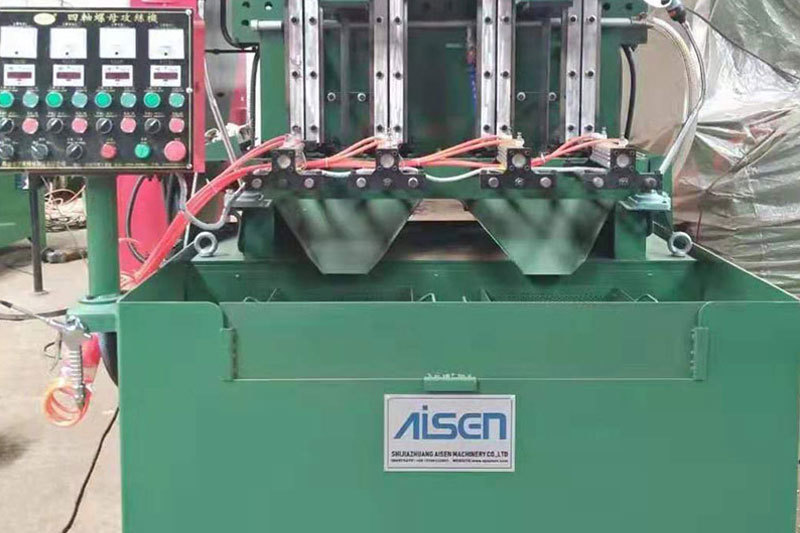
AISEN Four axis nut tapping machine ready for shipment to Russia
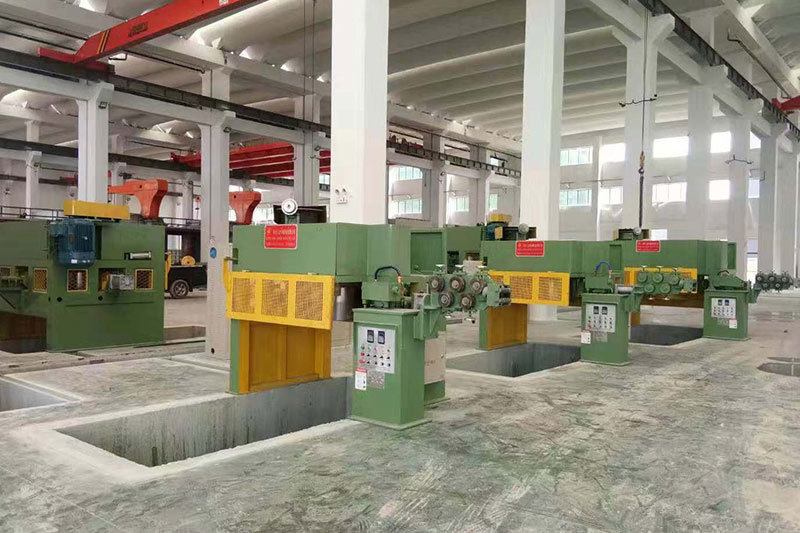
AISEN machinery inverted wire drawing machine
MESSAGES
We will contact you within one working day. Please pay attention to your email.
Qucik Link
Contact
Phone: +86-15100123091
E-mail: info@sjzaisen.com
Address: No.41 Zhaiying South Street, Yuhua District, Shijiazhuang City, Hebei Province China