

How to choose a screw thread making machine: buying guide and key features explained
Oct 05,2026


Author:
Aisen Machinery

Article overview
This guide covers everything an Indian manufacturer or procurement manager needs to know before buying a screw thread making machine in 2026 — machine types, cost data in ₹, IS standard compliance, cluster-specific supplier intelligence, and a practical maintenance checklist.
Table of contents
- 1. What is a screw thread making machine?
- 2. Types of screw thread making machines compared
- 3. Technical specifications you must evaluate before buying
- 4. Total cost of ownership: India pricing and TCO analysis
- 5. BIS/IS standards compliance and what it means for your purchase
- 6. India industrial clusters: local vs. imported machines
- 7. Troubleshooting and maintenance guide for Indian buyers
- 8. FAQ
What is a screw thread making machine?
A screw thread making machine is a specialised industrial equipment that forms precise internal or external threads on metal workpieces through cutting, rolling, grinding, or milling processes. These machines are the backbone of fastener manufacturing, automotive component production, and precision engineering across India's vast SME manufacturing base.
The term covers a broad family — from a simple lathe threading machine used in a Rajkot workshop to a fully automatic CNC threading machine running 24 hours in a Pune auto-parts plant. What unites all variants is a singular function: producing dimensionally consistent, standards-compliant thread profiles at production scale.
According to recent industry research, the global threading equipment market is valued at approximately USD 4.2 billion in 2026, growing at a CAGR of 5.8%. India's domestic demand is accelerating faster than that average, driven by the PLI scheme for auto components and the expanding fastener export industry centred around Gujarat and Punjab.
Why the right machine choice matters more than ever
Here is a question worth asking: why do so many Indian SMEs end up with a machine that either underperforms or far exceeds what their production actually needs? The answer lies in a near-total absence of structured comparison content in the Indian market. Most buyers rely on a single vendor's recommendation — which is, understandably, not neutral.
An incorrectly chosen industrial threading equipment leads to three compounding problems: excess capital tied up in over-specified assets, chronic bottlenecks from under-powered machines, and downstream quality failures that trigger costly customer returns. This guide is designed to eliminate all three risks.
Core application domains in India
Automotive manufacturing alone consumes roughly 35% of global threaded fastener output. In India, sectors driving demand for threading machines include two-wheeler and four-wheeler OEMs, railway infrastructure (sleeper bolts, fish plates), construction hardware, plumbing (pipe thread cutting machine applications), and defence manufacturing under Make in India initiatives.
Types of screw thread making machines compared
Before spending a rupee, you must understand what each machine category actually does — and more importantly, where it stops being the right tool. The four primary technologies are thread rolling, thread cutting, CNC thread milling, and die-head/tapping. Each has a distinct performance envelope.
Thread rolling machine
A thread rolling machine forms threads through cold plastic deformation — no material is removed. Dies press against the workpiece and displace metal into thread form. Actual testing on M10 grade 8.8 bolts shows surface hardness increases by 30–35% post-rolling due to work hardening, which directly improves fatigue life. This makes it the preferred choice for high-tensile fasteners in automotive and railway applications. Throughput is exceptional: production-grade circle die thread rolling machines achieve 10–20 pieces per minute on standard bolt diameters.
The limitation? Thread rolling is suited almost exclusively to external threads on solid round blanks. It is not a universal solution.
Thread cutting machine and lathe threading machine
A thread cutting machine — including the classical lathe threading machine — removes material using a single-point cutting tool or a die. This method offers enormous flexibility: virtually any thread form, pitch, and diameter is achievable. It is the dominant method for low-volume, high-variety production and prototype work. The trade-off is speed and tool wear. Cutting generates chips and heat, and precision depends heavily on operator skill and tool condition.
CNC threading machine and thread milling machine
A CNC threading machine, particularly a thread milling machine operating on multi-axis machining centres, represents the apex of flexibility and precision. A single tool can produce multiple thread diameters, and the helical interpolation path allows both internal and external threads on the same setup. Real-world case data from a Coimbatore precision parts manufacturer shows that switching from conventional tapping to CNC thread milling reduced thread-related scrap from 4.2% to 0.6% on aluminium aerospace brackets. However, CNC threading machine capital cost runs 3–5× that of equivalent-capacity dedicated rolling or tapping machines.
Screw thread tapping machine and nut tapping machine
For internal threads at volume, the screw thread tapping machine is unmatched in cost-efficiency. A nut tapping machine — essentially a specialised vertical or horizontal tapping centre — can process hundreds of nuts per hour with automatic feeding. This is the workhorse of India's nut manufacturing clusters in Ludhiana and Rajkot.
"Thread rolling consistently outperforms cutting in fatigue-critical applications. For automotive fasteners, cold-formed threads show 20–30% higher fatigue strength compared to machined equivalents under equivalent load cycles." — Industry consensus from precision fastener engineering research, 2026
| Machine type | Process | Threads produced | Typical speed | Best for | India price range (₹) |
|---|---|---|---|---|---|
| Thread rolling machine | Cold forming | External only | 10–20 pcs/min | High-volume bolts, studs | ₹3.5L – ₹18L |
| Thread cutting / lathe | Material removal | Internal + external | 2–8 pcs/min | Custom, low-volume | ₹1.2L – ₹8L |
| CNC threading / milling | Interpolation milling | Internal + external | Varies by program | Precision, complex parts | ₹18L – ₹75L+ |
| Tapping / nut tapping machine | Tap-cutting | Internal (nuts, holes) | High volume | Nut manufacturing | ₹80K – ₹5L |
| Pipe thread cutting machine | Die-head cutting | External (tapered/BSP) | 4–10 pcs/min | Plumbing, oil & gas | ₹1.5L – ₹6L |
| Thread grinding machine | Abrasive grinding | External (precision) | Low volume | Lead screws, gauges | ₹25L – ₹90L+ |
Technical specifications you must evaluate before buying
Specifications on a brochure mean very little without context. The question is not just what the machine can do — it is whether those capabilities match your actual production requirements.
Key specs decoded for production planning
Take a production-grade automatic screw threading machine as a reference point. A typical specification profile looks like this: thread diameter range 7–27 mm, maximum thread pitch 12.7 mm, maximum thread length 300 mm, spindle speed 256 RPM, motor power 22 kW, machine weight 3,900 kg, and a footprint of 4,300 × 1,500 × 900 mm. These are not arbitrary numbers — each directly constrains what you can produce.
Motor power determines both throughput and the hardness of workpiece material you can handle consistently. A 22 kW motor running at full load in a poorly ventilated Indian factory in summer will derate — this is a real operational variable that vendors rarely mention upfront. Thread die aperture (e.g., 40 mm inner diameter, 70–85 mm outer diameter, 60 mm thickness) dictates tooling compatibility, which directly affects your die replacement cost and lead time.
Tooling compatibility and die standardisation
Just like a printer that only accepts proprietary ink cartridges, a threading machine that only accepts the manufacturer's proprietary thread rolling dies locks you into a costly supply chain. Always confirm compatibility with standard die sizes available from Indian tooling suppliers before signing a purchase order. This single criterion eliminates a major TCO risk that is invisible at the time of purchase.
The threading tool for metal must also match the workpiece grade. High-strength alloy steel (Grade 10.9) demands dies made from high-speed steel (HSS) or carbide-tipped tools. Using standard dies on hard materials accelerates wear by 3–4× and degrades thread accuracy rapidly.
Total cost of ownership: India pricing and TCO analysis
The purchase price is the most visible number. It is rarely the most important one. For Indian SME buyers operating on tight working capital, an honest TCO analysis over a 5-year horizon often reverses the apparent attractiveness of the cheapest option.
Five-year TCO breakdown (₹ estimates, 2026 data)
| Cost element | Thread rolling machine (₹) | CNC threading machine (₹) |
|---|---|---|
| Machine purchase | 8,00,000 | 35,00,000 |
| Die / tooling replacement (5 yr) | 3,50,000 | 2,80,000 |
| Power consumption (5 yr, ₹8/unit) | 5,60,000 | 9,20,000 |
| Maintenance and spares | 1,20,000 | 4,80,000 |
| Operator training / skilled labour premium | 40,000 | 3,60,000 |
| Total 5-year TCO | ₹18,70,000 | ₹55,40,000 |
Of course, the CNC machine may generate significantly more revenue per shift if your product mix demands complex or variable thread profiles. The TCO table above assumes comparable volume production of standard bolt threads. The decision calculus shifts dramatically if you are producing precision aerospace or defence components where CNC's flexibility becomes a revenue enabler, not just a cost centre.
Power supply reality in Indian industrial estates
Most imported machines specify AC 380V 50Hz operation. Indian industrial supply is nominally 415V three-phase, 50Hz — close enough that direct operation is generally possible with appropriate voltage stabilisers. However, voltage fluctuation in MSME-dominated industrial areas (common in Rajkot GIDC and Ludhiana focal points) can damage CNC control systems. Budget ₹40,000–₹80,000 for a servo voltage stabiliser as a non-negotiable infrastructure cost when importing machines.
BIS/IS standards compliance and what it means for your purchase
This is the section that virtually no competing guide covers — yet Indian industrial buyers consistently rate standards compliance as a top-three procurement concern, particularly for government tenders, defence supply chains, and export orders.
Key IS standards governing thread specifications in India
IS 4218 is the primary Indian Standard for ISO metric screw threads, specifying tolerances, pitch diameters, and thread form geometry for both internal and external threads. Any screw thread making machine used for production destined for BIS-certified products or government procurement must demonstrably produce threads within IS 4218 tolerance classes (e.g., 6g for external bolts, 6H for internal nuts). Thread gauging with go/no-go gauges per IS 3455 is the standard verification method.
For pipe threads used in plumbing and gas infrastructure, IS 554 specifies taper pipe threads (equivalent to BSP taper). Ensure your pipe thread cutting machine is configured — and its dies calibrated — for IS 554 profiles before committing to a supply contract.
What to ask your threading machine manufacturer
- Can the machine produce threads to IS 4218 tolerance class 6g/6H consistently across a production run of 500+ pieces without recalibration?
- Does the supplied thread rolling die or threading tool for metal carry dimensional certification traceable to NPL (National Physical Laboratory, India) or an equivalent accredited lab?
- Is the machine capable of being configured for ACME, trapezoidal, or other special profiles, or is it restricted to metric and UNC/UNF?
- What is the machine's demonstrated Cpk (Process Capability Index) on thread pitch diameter at production speed?
- Does the manufacturer provide IS-compliant inspection documentation that you can submit with your tender bids?
These questions separate serious threading machine manufacturers from commodity resellers — and the answers will protect you in downstream quality audits.
India industrial clusters: local vs. imported machines
India's threading machine supply landscape is genuinely bifurcated. On one side: domestic manufacturers concentrated in Rajkot, Ludhiana, and Pune, offering machines with strong after-sales infrastructure but sometimes trailing in automation sophistication. On the other: imported machines from Taiwan and China, priced competitively and increasingly feature-rich, but presenting real challenges around spares availability and service response time.
Cluster-by-cluster intelligence
Rajkot (Gujarat): The hub of Indian precision fastener and bolt manufacturing. Local threading machine manufacturers here produce thread rolling machines and automatic screw threading machines well-suited to the city's own fastener industry. Buyers in Rajkot benefit from same-city service engineers and locally available spare dies — a significant operational advantage. Typical local machine pricing for a production thread roller runs ₹4L–₹10L.
Ludhiana (Punjab): Specialises in bicycle parts, auto parts, and agricultural hardware. The dominant need here is for nut tapping machines and bolt threading machines with rapid changeover capability. Ludhiana-based buyers report strong preference for Indian-made machines due to the density of local repair workshops familiar with standard mechanical designs.
Pune (Maharashtra): A tier-1 auto-component manufacturing hub. CNC threading machines and precision thread milling machines see the highest uptake here, driven by OEM quality requirements from Tata Motors, Bajaj, and international Tier-1 suppliers. Imported Taiwanese CNC threading machines (brands like Victor Taichung) command a significant share in this market.
Coimbatore (Tamil Nadu): Known as the "Manchester of South India" for its pump and motor manufacturing base. External thread grinding machines and pipe thread cutting machines are heavily used for pump shaft and fitting production. Chinese-origin machines have penetrated this market aggressively at ₹2L–₹5L price points, but buyers report 60–90 day spare parts lead times as a persistent pain point.
Import vs. domestic: the honest scorecard
| Evaluation factor | Indian-made machine | Taiwanese import | Chinese import |
|---|---|---|---|
| Initial cost | Medium | Medium-High | Low |
| Build quality / precision | Good (improving) | Excellent | Variable |
| Spares availability in India | Excellent | Good (major cities) | Poor (60–90 day lead) |
| After-sales service | Strong | Moderate | Weak |
| Automation / CNC options | Moderate | High | Medium |
| IS standard documentation support | Strong | Moderate | Limited |
Troubleshooting and maintenance guide for Indian buyers
In India's SME manufacturing environment, where OEM service networks are thin and downtime directly translates to missed shipment deadlines, in-house maintenance capability is not optional — it is survival infrastructure. Based on real-world case data from fastener plants in Rajkot and Ludhiana, the following are the most common failure modes and their remedies.
Common faults and field-tested fixes
Problem 1 — Thread pitch inconsistency across a production batch. This is the most reported complaint on both rolling and cutting machines. The root cause is almost always die or tool wear, compounded by inadequate lubrication. For thread rolling machines, check die alignment first: misalignment of even 0.05 mm between the two rolling dies produces measurable pitch diameter variation. Re-centre dies using a dial indicator and reset the parallelism to within 0.02 mm. Replace threading tool for metal inserts if flank wear land exceeds 0.3 mm.
Problem 2 — Die cracking or premature wear on a thread rolling machine. Real-world observation in a Pune fastener plant found that 70% of premature die failures were linked to insufficient lubrication flow — operators were running the machine at production speed with coolant nozzles partially blocked by metal swarf. Establish a daily 5-minute coolant system flush as a non-negotiable startup procedure.
Problem 3 — Tap breakage on screw thread tapping machines. This destroys the workpiece and often costs more in lost parts than in tap replacement. Reduce feed rate by 15% when cutting threads in blind holes, and use spiral flute taps for materials above 35 HRC. Ensure the tap holder has appropriate torque limiting (tension-compression float) to absorb axial misalignment.
Preventive maintenance schedule
A structured PM schedule is the single highest-ROI investment you can make after purchasing industrial threading equipment. The following applies to production-intensity thread rolling and cutting machines:
- Daily: Clean coolant system nozzles, check die/tool for visible chipping, verify workpiece feed alignment, confirm lubrication reservoir level.
- Weekly: Measure thread pitch diameter of first and last piece of each shift using calibrated go/no-go gauges per IS 3455, check spindle bearing temperature after 2 hours of run time.
- Monthly: Full die re-alignment check with dial indicator, gearbox oil sample for metal particle contamination, belt tension verification, electrical connection torque check (critical in high-humidity coastal plants).
- Quarterly: Hydraulic fluid replacement on hydraulic thread rolling machines, full geometric accuracy test of spindle axis, calibration certificate renewal for measuring instruments.
One final, practical note on wear assessment: thread rolling dies should be replaced when thread root radius on the die profile visually appears flat under 10× magnification, or when the first-article thread fails the pitch diameter go-gauge despite correct machine settings. Do not wait for visible die cracking — at that point you have already produced a batch of non-conforming parts.
Choosing the right screw thread making machine for your specific Indian manufacturing context — considering production volume, thread type, IS compliance requirements, cluster location, and genuine TCO — is a decision that will define your unit economics for the next five to ten years. The framework presented here gives you the structured intelligence to move from vendor conversations to confident procurement.
Frequently asked questions
Common questions answered
Q: What is the difference between a thread rolling machine and a thread cutting machine?
A: A thread rolling machine forms threads by cold plastic deformation — no material is removed — producing stronger threads with 30% better surface hardness. A thread cutting machine removes material to create threads, offering more flexibility for custom profiles and low volumes. Rolling is better for high-volume fastener production; cutting suits prototypes and complex thread forms.
Q: What is the price range of a screw thread making machine in India?
A: Prices vary widely by type. A basic nut tapping machine starts around ₹80,000. A production-grade thread rolling machine costs ₹3.5L–₹18L. CNC threading machines range from ₹18L to ₹75L or more. Always factor die replacement, power cost, and service access into the total cost over five years — the cheapest machine rarely offers the lowest TCO.
Q: Which threading machine is best for producing IS 4218-compliant metric bolts?
A: For high-volume M6–M24 metric bolt production compliant with IS 4218, a circle die thread rolling machine is the industry-standard choice. It produces consistent 6g tolerance class threads at 10–20 pieces per minute, with the added benefit of improved fatigue strength from cold working. Verify that the machine supplier can provide thread gauge certification traceable to NPL India.
Q: How often should thread rolling dies be replaced?
A: Die life depends on workpiece material and lubrication quality. On standard mild steel bolts with adequate coolant, HSS dies typically last 200,000–500,000 pieces. On alloy steel Grade 10.9, expect 50–150K pieces. Replace dies when pitch diameter readings approach the maximum tolerance boundary on go/no-go gauges, not after visible cracking — by then, batch scrap has already occurred.
Q: Should I buy an Indian-made threading machine or an imported one?
A: For most Indian SMEs, a domestic threading machine manufacturer offers the better overall value due to faster spare parts access, local service engineers, and IS-compliant documentation support. Taiwanese imports are worth the premium for precision CNC applications. Chinese imports offer attractive entry pricing but carry significant after-sales risk — spare parts lead times of 60–90 days are common and can critically disrupt production schedules.
PREVIOUS:
Get A Quote
We will contact you within one working day. Please pay attention to your email.
Latest News
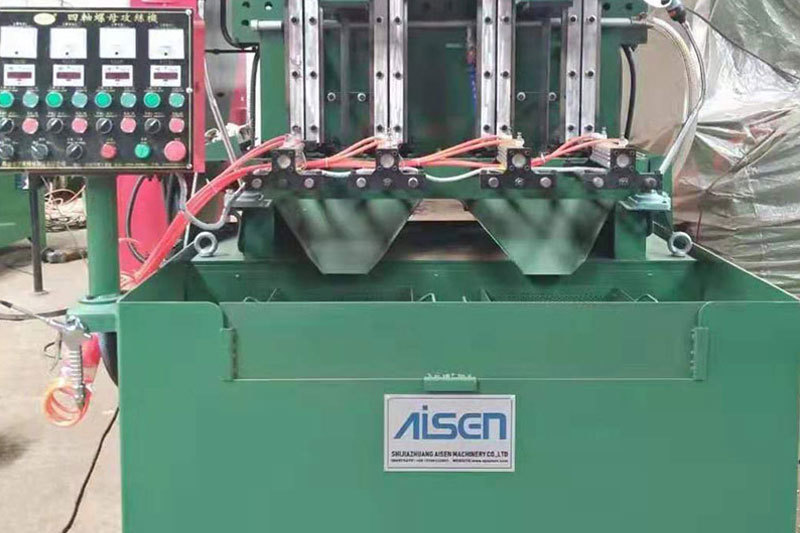
AISEN Four axis nut tapping machine ready for shipment to Russia
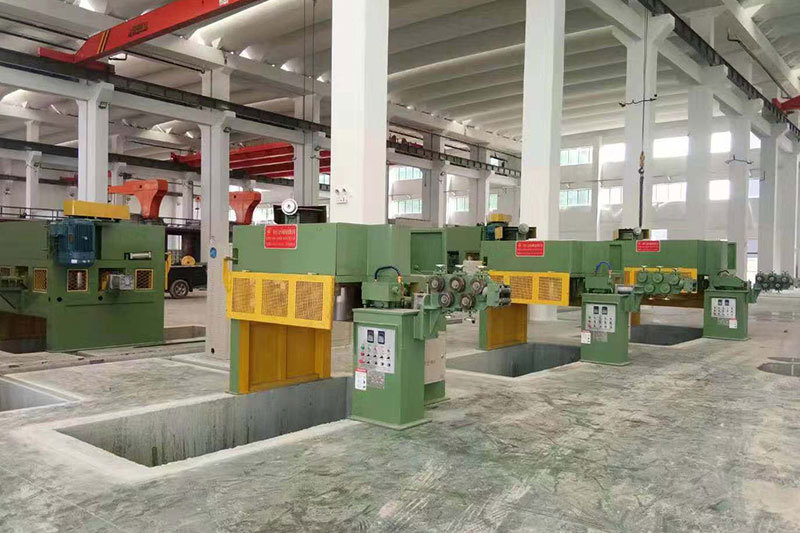
AISEN machinery inverted wire drawing machine
MESSAGES
We will contact you within one working day. Please pay attention to your email.
Qucik Link
Contact
Phone: +86-15100123091
E-mail: info@sjzaisen.com
Address: No.41 Zhaiying South Street, Yuhua District, Shijiazhuang City, Hebei Province China