

Roll forming line buyer's guide: what to look for before purchasing
Nov 07,2026


Author:
Aisen Machinery

Article overview
Roll forming line is a continuous metal forming system that uncoils steel strip, drives it through progressive roll stands, and delivers a finished constant-section profile — punched and cut to length — in a single pass. This guide is written for Indian fabricators, PEB contractors and profile manufacturers comparing quotations in 2026. It covers sizing, rupee price bands, payback arithmetic, flower pattern design, changeover economics, compliance and after-sales verification, using Indian steel demand data and shop-floor observations rather than brochure claims.
Table of contents
- 1. What a roll forming line does that a press brake cannot
- 2. Sizing the line: strip width, thickness and speed
- 3. Roll forming machine price in India in 2026
- 4. Flower pattern, roll design and changeover economics
- 5. Service, spares and commissioning
- 6. Verifiable running data beats any testimonial
- 7. Shortlisting a roll forming line supplier
1. What a roll forming line does that a press brake cannot
A roll forming line wins on repetition, never on flexibility. Once the rolls are set, every metre leaving the machine is dimensionally identical — no brake operator's mood swings, no 3-metre bend limit, no second handling pass.
The five sub-systems you are actually buying
What the invoice calls a machine is really five systems working as one: a decoiler with coil car, a leveller, the roll former itself, a punching or notching station, and a flying cut-off with run-out and stacking. In the quotation comparisons we have run for Indian buyers, the uncoiler, leveller and stacker together account for roughly a fifth of the price — and they are precisely the sections nobody inspects during a factory visit.
Specify the leveller by roll diameter and backup-roller count, not by the word "leveller" alone. A poorly supported leveller leaves coil set in the strip, and coil set becomes twist in your finished profile that no amount of roll adjustment will remove.
Where the money leaks after commissioning
The leaks start with the coil, not the machine. Indian CRCA and galvanised stock varies in thickness and yield strength from lot to lot. A line tuned around one nominal grade will drift the moment a harder coil arrives — and the drift gets blamed on the operator, which is why the real cause goes unfixed for months.
So why do purchase committees still approve on price per tonne? Because scrap is invisible on a balance sheet until someone reconciles coil consumed against despatched tonnage. Do that reconciliation yourself for the first 60 days.
Above the line sits the roll forming overview literature on material behaviour, and below it sits your blank supply: a coil processing line or cut-to-length line decides flatness before the strip ever reaches the first stand.
Of course, a press brake and a hand-fed roll former still make sense below roughly 150 sheets a month on one-off long-span profiles. The case for a full automated line only closes once monthly volume becomes predictable.
2. Sizing the line: strip width, thickness and speed against your order book
Size the line from the heaviest profile you will run at least twice a week — not from the widest catalogue claim. Buyers who size for the rare 6 mm order end up paying for stands and tonnage they never use, while buyers who size for the average order spend every heavy job apologising to customers.
The width, thickness and speed matrix Indian buyers should demand
| Line type | Strip width | Thickness | Practical speed | Stations | Changeover |
|---|---|---|---|---|---|
| Purlin (C/Z) | 100–400 mm | 1.5–4.0 mm | 12–25 m/min | 14–18 | 3–8 h fixed / 30–45 min cassette |
| Roof & wall panel | 1000–1250 mm | 0.30–0.80 mm | 18–35 m/min | 12–20 | 20–40 min |
| Floor decking | 600–1000 mm | 0.8–1.6 mm | 10–20 m/min | 20–26 | 4–6 h |
| Ceiling / partition section | 60–200 mm | 0.30–0.80 mm | 25–45 m/min | 8–12 | 20–30 min |
| Cable tray | 100–600 mm | 0.8–2.0 mm | 10–18 m/min | 14–20 | 45–90 min |
| Shutter door | 150–400 mm | 0.40–1.20 mm | 12–20 m/min | 10–14 | 30–60 min |
Demand this matrix filled in writing, with the coil yield strength assumed. The context matters too: India produced 168.4 million tonnes of crude steel and 160.9 million tonnes of finished steel in FY26, with capacity at 220 million tonnes heading for 300 million tonnes by 2030, according to IBEF. ICRA expects domestic steel demand to grow 9–10%. Plenty of coil, in other words — but not uniform coil.
Why nameplate line speed rarely appears on the shop floor
Nameplate speed is a no-load number. Real throughput runs at 55–70% of it once cut-off cycling, coil changes and stacking are counted. A 25 m/min purlin line forming 2 mm strip realistically delivers 850–1,100 kg per hour, not the four tonnes the arithmetic in the brochure implies.
Ask for tonnes per shift at a stated thickness and profile. A steel roll forming line supplier who answers in kilogrammes per hour, at your profile, knows their machine. One who answers in metres per minute is quoting a datasheet.
3. Roll forming machine price in India: what your rupees buy in 2026
Expect to pay between ₹9 lakh for a compact single-profile former and ₹1.6 crore for a high-tensile decking line with servo control and quick-change cassettes. Anything quoted far below the band is usually a lighter frame, thinner shafts, or a hydraulic system sourced without service backup.
Indicative price bands by line type
| Line | Indicative ex-works price, 2026 | What pushes it up |
|---|---|---|
| Ceiling / partition section | ₹9–18 lakh | Second profile on same shaft |
| Shutter door | ₹12–24 lakh | Cassette system (+₹4–7 lakh) |
| Cable tray | ₹18–38 lakh | Width adjustment by spacers |
| Solar bracket profile | ₹25–50 lakh | High-strength 550 MPa tooling |
| Purlin C/Z, 1.5–4 mm | ₹35–75 lakh | Servo + quick change → ₹85 lakh–1.2 crore |
| Floor decking | ₹70 lakh–1.6 crore | Extra stands for high-tensile strip |
A payback model you can re-run
Take a ₹55 lakh purlin line running 2 mm strip at 900 kg/h. Two shifts of 16 hours across 300 days gives 4,320 tonnes at full utilisation; at a realistic 55% utilisation the figure is about 2,376 tonnes a year. On a conversion margin of ₹3 per kg, that is roughly ₹71 lakh of gross contribution. Deduct power, labour and roll maintenance at about ₹18 lakh, and net contribution lands near ₹53 lakh — a payback of 12 to 14 months, stretching to 20 months if your order book softens.
That is a worked illustration, not a promise. Payback in this industry tracks order book depth far more than machine specification.
Duty, BIS and ISO: the line item nobody quotes
Imported machines carry basic customs duty, a social welfare surcharge and 18% IGST on top of CIF value — confirm the exact classification with your CHA before you compare landed costs, because a domestic quote and an import quote are not the same number. On the output side, cold-formed sections are typically specified against IS 811, galvanised sheet against IS 277, and buyers increasingly ask the machine builder for ISO 9001 documentation.
This is where roll forming line manufacturers in India have a structural advantage: landed cost transparency, rupee invoicing and a service engineer reachable by train rather than by visa.
4. Flower pattern, roll design and changeover economics
The flower pattern decides whether your line makes good profiles for fifteen years or fights you for five. It is the pass-by-pass sequence showing how flat strip folds into the final section, and it should be handed to you as a drawing before you release a purchase order.
How many forming stations do you actually need?
Fewer than the salesman suggests, usually. Each pass should bend 8–12° of arc for mild steel; beyond that, edge strain and oil-canning appear. A 1.5–4 mm purlin needs 14–18 stands, a shutter door profile 10–14, floor decking 20–26 because of the stiffening ribs. High-tensile 550 MPa strip needs more passes or larger roll diameter — springback does the rest.
"Pass count, roll diameter and bending angle are dictated by the profile geometry and the material's yield strength — not by adding stands until the shape closes."— Engineering consensus reflected in the published roll forming process literature, and in every tooling review we have sat through.
Changeover time is the second price tag
Fixed-roll lines take 4–8 hours to move between profiles. Rafted or cassette systems cut that to 25–45 minutes; motorised quick-change reaches 10–15 minutes. Run the arithmetic: at 900 kg/h and ₹3/kg contribution, a 6-hour changeover burns ₹16,200 of margin before the first good metre.
If you run more than four profile changes a week, the cassette premium pays for itself inside a year. If you run one profile for nine months, it never will — and a good supplier will tell you so instead of upselling.
What to specify on roll material and hardening
Ask for D2 or SKD-11 tooling at 58–62 HRC, hard chrome plating of 0.02–0.03 mm, and ground finish on the forming faces. Shaft diameter should scale with strip thickness — an undersized shaft deflects under load and the deflection shows up as a wandering flange.
5. Service, spares and commissioning: the part brochures skip
Downtime costs more than the machine. A line stopped for want of a ₹4,000 hydraulic valve can idle an entire shift, and no price discount survives three weeks of that.
Six questions that expose a weak service promise
Ask where the nearest service engineer is based, and how many days to reach your plant. Ask the lead time on a full replacement roll set. Ask whether roll regrinding is handled in-house or outsourced. Ask if the PLC supports remote diagnostics. Ask what the annual maintenance contract costs as a percentage of line value — typically 3–5%. Ask for two customers running the same model for over three years.
Vague answers to any of those six are your answer. A serious roll forming line supplier keeps a spares list priced and dated, because they have shipped it before.
Delivery and commissioning benchmarks to hold a supplier to
Domestic build and delivery runs 8–14 weeks; imported lines run 16–24 weeks plus freight and clearance. Commissioning should take 5–10 days, with 3–5 days of operator training included rather than billed. Budget 2% of line value as an initial critical spares kit: cut-off blade, encoder, servo drive, hydraulic valve bank, bearing set.
Get these written into the PO with a liquidated damages clause. Suppliers who plan their shop floor properly will sign it.
6. Verifiable running data beats any testimonial
A photograph of a machine with a ribbon does not tell you whether the line holds tolerance at 3 mm. Running data does, and most buyers never ask for it.
The five numbers to request before signing
Ask for OEE over a six-month window (55–70% is normal for this equipment class), scrap percentage (under 1% is achievable; many lines run 0.8–2%), specific energy consumption (25–45 kWh per tonne on a purlin line with hydraulic shear), mean time between failures on the cut-off, and dimensional capability on the critical flange — ±0.5 mm on purlin depth is a fair benchmark.
One caveat: figures from a single showroom machine prove little. Ask for a week's production log from a customer plant, redacted if necessary.
What does a good customer case actually look like?
A usable case names the profile, the strip grade and thickness, the shift pattern, and the specific problem solved — say, a Coimbatore-based profile maker running cable tray roll forming machine output who cut changeover from five hours to forty minutes and lifted monthly tonnage by a fifth. Vague praise is decoration; a before-and-after number is evidence.
The same applies to a shutter door roll forming machine or a purlin roll forming machine reference: insist on seeing output that matches your own specification, not a heavier cousin.
7. How to shortlist a roll forming line supplier in seven steps
Shortlisting is a filter, not a beauty parade. Run the same specification through every candidate and let the answers separate them.
The seven-step shortlisting sequence
- Write a one-page profile specification: section drawing, strip width, thickness range, yield strength, hourly target and annual tonnage.
- Send that identical sheet to four to six suppliers, including at least two Indian builders and one importer for landed-cost comparison.
- Demand a flower pattern drawing and a roll layout with every quotation — no drawing, no shortlist.
- Ask each supplier to form your profile on an existing machine and send unedited video of the run.
- Convert every quote to landed cost at your plant: freight, duty, erection, training, spares kit and AMC for three years.
- Verify service reach and spares lead times against the written commitments in section five.
- Negotiate training, the critical spares kit and a performance-test clause into the PO before discussing discount.
Red flags in the negotiation room
Walk away from a supplier who cannot produce a flower pattern, promises one line will run "any profile of the same width" with minor adjustment, refuses a trial video, or quotes a roll forming machine price in India far under the band without explaining what was removed. Watch also for the profile roll forming machine marketed as fully automatic when the changeover is still manual.
The wider metal roll forming equipment market rewards patience. Domestic builders compete hard on delivery speed and after-sales reach, and that competition is your leverage — use it by comparing like with like, in rupees, at your own gate.
Buy the line that fits your order book, not the one that photographs best. A sheet metal roll forming machine sized 20% above your real demand is a depreciating asset; one sized correctly, with a documented flower pattern and a service engineer two hours away, is a margin engine for a decade. That is the whole of the roll forming line decision, and everything else is paperwork.
Frequently asked questions
Q: How much does a roll forming line cost in India in 2026?
A: Indicative ex-works prices start near ₹9 lakh for a compact ceiling-section former and reach ₹1.6 crore for a high-tensile decking line. A standard 1.5–4 mm purlin line sits between ₹35 lakh and ₹75 lakh, with servo control and quick-change cassettes adding a further ₹30–45 lakh.
Q: What is the difference between a roll forming line and a roll former?
A: A roll former is the roll stand assembly that bends the strip. A roll forming line is the complete system around it — decoiler, leveller, roll former, punching station, cut-off and stacker — plus controls, sized to run continuously from coil to stacked finished profile.
Q: How long does a profile changeover take?
A: Fixed-roll lines need 4–8 hours. Rafted or cassette systems reduce this to 25–45 minutes, and motorised quick-change designs reach 10–15 minutes. If you change profiles more than four times a week, the cassette premium typically repays itself within a year.
Q: Which certifications should I check before buying?
A: Check ISO 9001 for the machine builder, IS 811 and IS 277 for the cold-formed and galvanised output you intend to sell, and a CE marking if you export. For imported lines, confirm customs classification and duty with your CHA before comparing landed cost.
Get A Quote
We will contact you within one working day. Please pay attention to your email.
Latest News
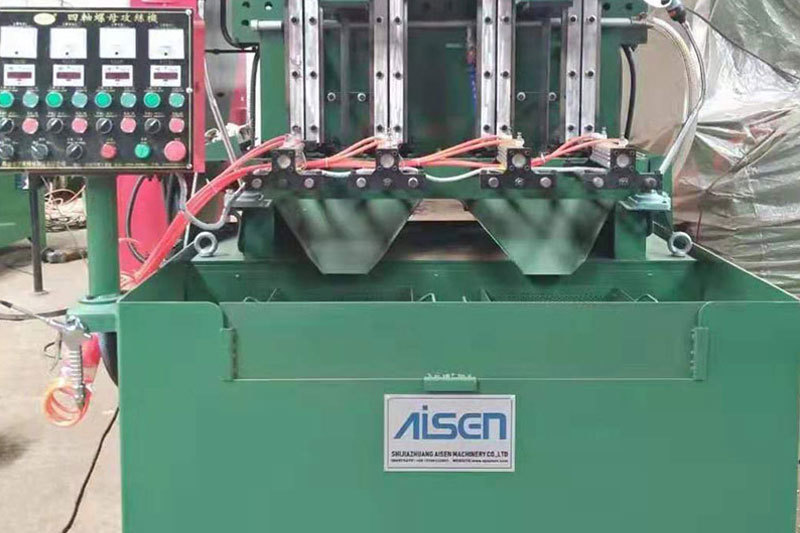
AISEN Four axis nut tapping machine ready for shipment to Russia
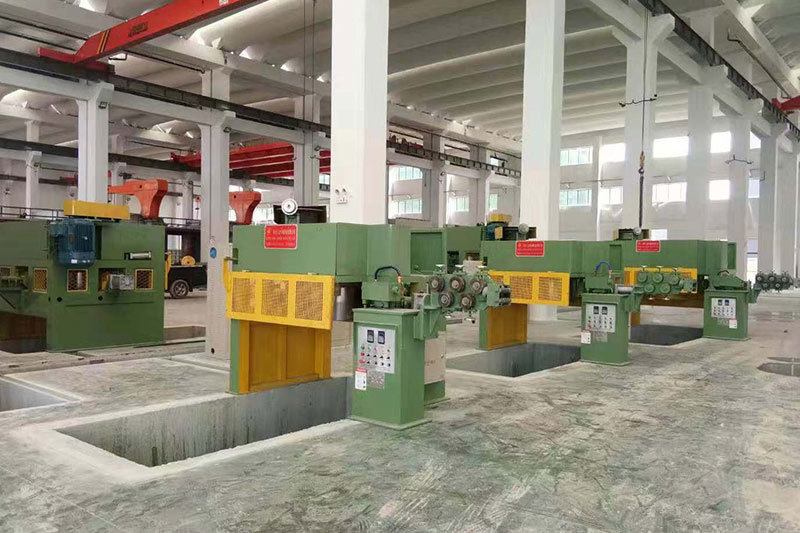
AISEN machinery inverted wire drawing machine
MESSAGES
We will contact you within one working day. Please pay attention to your email.
Qucik Link
Contact
Phone: +86-15100123091
E-mail: info@sjzaisen.com
Address: No.41 Zhaiying South Street, Yuhua District, Shijiazhuang City, Hebei Province China