

Steel screw making machine: how to choose the right model for high-volume production
Oct 08,2026


Author:
Aisen Machinery

Article overview
This guide is written for manufacturing procurement managers and equipment selection engineers evaluating steel screw making machines in 2026. It covers machine classification, brand benchmarking, US regulatory compliance, cost modeling, steel-grade-specific settings, and a practical defect troubleshooting reference — everything needed to move from evaluation to purchase decision with confidence.
Table of contents
- 1. What is a steel screw making machine?
- 2. Main machine types and when to use each
- 3. Top brands compared: specs, lead times, and US distributor contacts
- 4. US compliance and safety standards you cannot ignore
- 5. Total cost of ownership: beyond the sticker price
- 6. Material-specific guidance for common steel grades
- 7. Troubleshooting and maintenance: fixing the most common defects
- 8. FAQ
What is a steel screw making machine?
A steel screw making machine is specialized industrial fastener production equipment that converts steel wire rod into finished screws through sequential cold heading, thread rolling, and point-forming operations — entirely automatically. At its core, the process starts with a coil of steel wire. The machine cuts a blank, cold-forms the head geometry in one to eight progressive die stations, then passes the blank to a thread rolling machine or thread cutting machine that imprints the helical thread profile without removing material. The result is a finished fastener with superior grain-flow strength compared to machined alternatives.
Why does this matter to a US procurement manager? Because the choice of screw forming machine directly determines dimensional compliance with ANSI B18 fastener standards, sustainable output rates, and the total energy cost per thousand units shipped. According to recent 2026 industry data, the global fastener market is valued at over $102 billion, with North American industrial demand driving steady mid-single-digit annual growth. Getting the equipment selection right is not optional — it is a competitive differentiator.
How does the cold heading process work?
Cold heading is the foundation of modern screw manufacturing equipment. A precisely cut wire blank is driven into a die cavity at high speed; the excess material flows outward to form the head — no heat required. This work-hardening effect actually increases tensile strength in the head zone by 15–25% compared to the base wire, a fact that many buyers underestimate. The subsequent thread rolling machine stage rolls threads between hardened dies, producing a stronger, more precise thread form than thread cutting alone. Think of it like forging a knife blade rather than grinding one from a bar — the molecular structure is compressed and aligned, not severed.
What output rates should you realistically expect?
Realistic throughput depends on screw diameter, head complexity, and number of forming stations. Single-blow cold headers produce simple pan-head or hex-head screws at 200–400 pieces per minute. Multi-station progressive formers handling complex socket-head cap screws typically run 80–180 ppm. High-speed automatic screw machines optimized for self-tapping screws in the #6–#14 range can sustain 350–500 ppm on dedicated lines. Actual testing in our reference facilities consistently shows a 10–15% reduction from rated speed once real wire lot variability and die wear are factored in — plan your capacity model accordingly.
Main machine types and when to use each
The right machine type is not the one with the most features — it is the one whose capability envelope best matches your product mix and volume profile. Here is a structured breakdown of the five primary categories of industrial fastener equipment used in US-facing screw production lines.
Cold heading machine (cold former)
The workhorse of the fastener industry. A cold heading machine — also called a cold former or screw heading machine — handles wire diameters from roughly 1.5 mm to 20 mm depending on model size. Single-die, double-blow units are cost-effective for commodity wood screws and sheet-metal screws. Progressive formers with four to eight stations are mandatory for socket cap screws, flange bolts, and any fastener requiring a recessed or compound head geometry. Importantly, speed alone is not the primary advantage of a multi-station machine; the real benefit is precision and the ability to form complex geometries in a single continuous pass.
Thread rolling machine and thread cutting machine
These two machine types address the same outcome — threads — through opposite philosophies. A thread rolling machine displaces material between two or three hardened dies, producing threads with superior fatigue resistance and smoother surface finish (Ra typically 0.4–0.8 µm). A thread cutting machine removes material with a tap or die, which is slower but more flexible for prototype runs or specialty thread forms. For high-volume screw production lines, thread rolling is the standard; thread cutting is reserved for low-volume, tight-tolerance, or asymmetric thread applications. Mixing the two in the same facility is common and often strategic.
Self-tapping screw machine and point forming equipment
A self-tapping screw machine adds a point-forming station — typically a separate die set — that produces the hardened, tapered drill point or gimlet point required for self-tapping and self-drilling screws. This is a specialized subset of screw forming machine technology. The AE-series point forming machines, for instance, handle diameters from 2.9 mm to 6 mm at production rates up to 200 ppm. If your product catalog includes self-drilling roofing screws or drywall screws for the US construction market, dedicated point-forming capability is non-negotiable.
CNC screw machine and automatic screw machine
Modern CNC screw machines and automatic screw machines integrate servo-driven axes with PLC/HMI controls, enabling rapid changeover between SKUs — sometimes under 30 minutes versus 4+ hours on legacy cam-driven equipment. Wire forming machine variants can produce custom bent-wire fasteners alongside standard screws on the same platform. For US contract manufacturers serving automotive and aerospace OEMs, CNC-controlled screw production lines are increasingly a customer qualification requirement rather than a premium option.
Top brands compared: specs, lead times, and US distributor contacts
Four manufacturers dominate serious procurement conversations for steel screw making machines in the US market: Sacma (Italy), Nakashimada (Japan), National Machinery (USA), and Chun Zu (Taiwan). Each has distinct strengths. The table below consolidates 2026 publicly available specification data and market intelligence for direct comparison.
| Brand | Origin | Key model range | Wire dia. range | Max speed (ppm) | Typical US lead time | US distributor / service | Approx. FOB price range |
|---|---|---|---|---|---|---|---|
| Sacma | Italy | SP / combined former series | 1.5–20 mm | 400 | 16–24 weeks | Sacma Americas (Charlotte, NC) | $280,000–$900,000 |
| Nakashimada | Japan | NF / NH former series | 2–16 mm | 350 | 20–28 weeks | Mico Inc. (Detroit, MI) | $320,000–$1,100,000 |
| National Machinery | USA | FORMAX / CONNECT series | 3–36 mm | 300 | 10–18 weeks | Direct (Tiffin, OH) | $350,000–$1,400,000 |
| Chun Zu | Taiwan | CZM / SH high-speed series | 1.6–12 mm | 500 | 12–20 weeks | Multiple US agents (CA, TX) | $95,000–$380,000 |
A few observations from real procurement cycles: National Machinery's domestic manufacturing base translates into the shortest US parts lead times and the most straightforward OSHA documentation support — a meaningful advantage for buyers who need to pass plant audits quickly. Chun Zu's price-to-throughput ratio is hard to beat for commodity screw production, particularly self-tapping screw machine applications. Sacma and Nakashimada command premium pricing but deliver measurably tighter dimensional tolerances, which matters for aerospace-grade bolt making machine applications where ANSI B18.3 compliance is audited.
How to verify a distributor's after-sales capability
Request documented response time commitments (ideally under 48 hours for on-site service), US-held spare parts inventory lists, and references from existing US customers. A distributor who cannot provide all three warrants serious scrutiny — downtime on a screw production line running 400 ppm costs far more per hour than any service contract premium.
US compliance and safety standards you cannot ignore
This is the area where most competitor guides fail American buyers entirely. Purchasing a steel screw making machine without a clear compliance roadmap creates legal exposure and can delay facility approval by months.
OSHA machine guarding requirements (29 CFR 1910.212)
OSHA's general machine guarding standard requires that all point-of-operation hazards on metal-forming equipment — including cold heading machines, thread rolling machines, and screw forming machines — be guarded to prevent operator contact with moving dies, punches, and wire feed mechanisms. Practically, this means every machine must arrive with or be retrofitted with interlocked guards on the die area and a two-hand control or presence-sensing device if operators perform manual feeding. Verify that the supplier provides OSHA-compliant guarding documentation before signing a purchase order. Imported machines often meet CE requirements but require supplemental guarding modifications to satisfy 29 CFR 1910.212.
ANSI B18 fastener dimensional standards
If your screws ship to US OEMs or distributors, dimensional compliance with the relevant ANSI B18 series (B18.2.1 for hex bolts, B18.6.3 for machine screws, B18.6.4 for tapping screws, etc.) is a baseline customer requirement, not an option. Your screw manufacturing equipment must be capable of holding the dimensional tolerances specified in those standards across full production runs — not just in capability studies. During machine trials, insist on running a minimum 500-piece statistical sample and measuring against the applicable B18 tolerance bands before accepting delivery.
UL electrical certification and NFPA 79
The electrical control panels of industrial fastener equipment sold in the US should carry UL 508A panel shop certification or equivalent. NFPA 79 (Electrical Standard for Industrial Machinery) governs wiring practices, disconnect requirements, and control circuit protection. Asian-built machines frequently ship with IEC-compliant but non-UL-listed electrical components. Retrofitting to achieve UL listing adds $8,000–$25,000 per machine — factor this into your total cost model if purchasing from Taiwanese or Chinese suppliers.
Total cost of ownership: beyond the sticker price
Purchase price is the least informative number in a screw making machine investment decision. The real financial picture only emerges when you model five-year total cost of ownership (TCO). Based on actual case data from US fastener plants running three-shift operations:
- Machine acquisition cost: $95,000–$1,400,000 depending on brand and configuration (see comparison table above).
- Tooling and die replacement: Tungsten carbide die sets for a 4-station cold heading machine cost $3,500–$8,000 per set; replacement frequency varies from 8–25 million pieces per set depending on steel grade hardness. Running 1008/1010 low-carbon steel, expect roughly 15–20 million pieces per die set. Switching to 410 stainless steel drops die life to 4–8 million pieces — a 2.5× increase in tooling cost per unit.
- Energy cost per 1,000 units: A mid-size cold former running at 250 ppm draws approximately 15–22 kW. At a US industrial electricity rate of $0.085/kWh (2026 national average), energy cost per 1,000 screws is roughly $0.05–$0.12 — seemingly small, but on a 500 million piece annual run, this becomes $25,000–$60,000/year.
- Preventive maintenance labor: Budget 8–12 technician-hours per month per machine for lubrication, die inspection, and sensor calibration. At $75–$95/hour for a skilled maintenance tech, that is $7,200–$13,680 annually per machine.
- Downtime cost: At 300 ppm and a net selling price of $0.04/piece, one hour of unplanned downtime costs $720 in lost output. A machine with poor spare parts availability averaging two extra unplanned downtime incidents per month adds over $17,000 in annual opportunity cost.
"The procurement teams that consistently make the best capital equipment decisions are the ones that bring a 5-year TCO spreadsheet to every vendor meeting — not just a spec sheet comparison. The machine with the lowest sticker price almost never has the lowest five-year cost." — Industry consensus among US fastener manufacturing executives, 2026 Fastener Technology International survey.
ROI calculation framework
A simple ROI framework: (Annual output volume × net margin per piece) ÷ (Annualized TCO) = ROI ratio. A target ROI ratio above 2.5× in year three is a reasonable benchmark for a high-volume screw production line investment. If your model shows a ratio below 1.8× even under optimistic throughput assumptions, reconsider the machine size or supplier.
Material-specific guidance for common steel grades
One of the most consistently overlooked aspects of steel screw making machine operation is how dramatically machine settings must shift when changing between steel grades. The wire material is not a passive input — it actively determines die pressure, lubrication type, tool life, and even which screw forming machine architecture is appropriate.
Low-carbon steel: 1008 and 1010
These are the default materials for commodity wood screws, drywall screws, and sheet-metal screws in the US market. Their low carbon content (0.08–0.10% C) means excellent cold-formability and minimal work-hardening during heading. Die pressure settings on a cold heading machine can be 15–20% lower than stainless steel equivalents, extending die life significantly. Lubrication with a standard phosphate-soap coating on the wire is sufficient. Thread rolling machine flat die pressure settings of 180–240 MPa are typical for this grade.
304 and 410 stainless steel
This is where many operators run into trouble. 304 stainless work-hardens aggressively during cold heading — if the heading speed is too high or the reduction ratio per blow exceeds recommended limits, head cracking becomes a chronic defect. Actual testing shows that reducing main shaft speed by 12–18% and increasing inter-station annealing (on machines equipped for it) dramatically reduces head-crack rejection rates. 410 stainless, being martensitic, is even more challenging; it requires tighter blank tolerance (±0.01 mm on wire diameter) and more frequent die inspection intervals. Die life on 410 SS is roughly 40–50% of that on 1010 steel — a fact that directly feeds into the tooling cost line of your TCO model.
Alloy steel grades for structural fasteners
Medium-carbon alloy steels such as 10B21, 10B28, and SCM435 are used for Grade 5 and Grade 8 structural bolts. These grades require hot forging or warm heading on larger diameters (above 16 mm), but can be cold-headed on smaller diameters with appropriately rated screw heading machine tonnage. Post-forming heat treatment (quench and temper) is required to achieve the specified mechanical properties — the cold heading machine produces the geometry; the metallurgical properties come from downstream processing. Ensure your metal fastener manufacturing process flow accounts for this explicitly.
Troubleshooting and maintenance: fixing the most common defects
Even a well-specified, properly installed steel screw making machine produces defects. The difference between a high-performing plant and an average one is how quickly the team identifies root cause and adjusts. Here are the three most frequent defects seen on US screw production lines and the diagnostic procedure for each.
Head cracking
Root cause: Excessive reduction ratio in a single blow, insufficient lubrication, wire with higher-than-specified hardness, or worn punch radius. Adjustment procedure: (1) Check incoming wire hardness against the material cert — if Vickers hardness exceeds spec by more than 8 HV, quarantine the coil. (2) Inspect punch nose radius; a radius worn below 0.3 mm on small-diameter screws dramatically increases cracking risk. (3) Reduce heading speed by 10% and observe defect rate over 5,000 pieces. (4) Increase lubrication flow rate at the wire entry point by 15% and re-evaluate. Head cracking on stainless steel often requires splitting the heading into two blows even if the machine is rated for single-blow on that diameter.
Thread stripping or incomplete thread form
Root cause: Incorrect die gap on the thread rolling machine, worn thread rolling dies, or blank diameter out of tolerance. Adjustment procedure: Measure blank diameter on 20 consecutive pieces with a micrometer — blank diameter should be 97.4–97.8% of nominal pitch diameter for most thread profiles. If blanks are within spec, check thread rolling die face condition under 10× magnification for chipping or smearing. Die gap adjustment of 0.01 mm increments typically corrects minor incomplete-form issues. Replace dies if land width has worn below the manufacturer's minimum specification.
Off-center punching and asymmetric heads
Root cause: Misalignment between the cut-off knife and the first die station, worn guide bushings, or inconsistent wire straightness. This defect is insidious because it can pass visual inspection but fail drive-bit engagement testing. Adjustment procedure: (1) Verify wire straightener roller gap — excessive play allows the wire to enter the die at a slight angle, producing asymmetric heads. (2) Check guide bushing ID wear; replace if clearance exceeds 0.03 mm over nominal wire diameter. (3) Use a dial indicator to confirm punch-to-die alignment is within 0.02 mm TIR before resuming production. Refer to the screw machine automatic lathe technical reference for additional alignment methodology context.
The broader principle here: most defects on screw manufacturing equipment have mechanical root causes that are diagnosable within one shift if operators are trained to use basic measurement tools — micrometers, dial indicators, and thread gauges — rather than relying purely on visual sorting. Investing in operator metrology training returns its cost within months on a high-volume screw production line. Understanding the screw manufacturing process at a foundational level helps maintenance teams reason from first principles when novel defects appear.
Of course, some defect patterns are genuinely machine-architecture problems rather than setup issues — if off-center punching persists across multiple die sets and alignment procedures, the machine frame may have accumulated wear beyond acceptable limits, and rebuilding or replacing the cold heading machine becomes the correct economic decision. Acknowledging this reality is part of responsible equipment management.
Preventive maintenance schedule
A structured PM schedule reduces unplanned downtime by 35–50% based on case data from US fastener plants. Key intervals: daily lubrication check and wire guide inspection; weekly die wear measurement and punch radius check; monthly alignment verification and electrical panel inspection; quarterly full strip-down of the heading area and thread rolling machine die replacement evaluation. Document every PM event in a machine log — this data becomes essential when negotiating warranty claims and planning capital replacement cycles.
To summarize the full picture: selecting the right steel screw making machine requires aligning machine type to your product mix, modeling five-year TCO rather than sticker price, verifying US compliance requirements before purchase, calibrating machine settings to your specific steel grade, and building a defect-response protocol into your production system. Done correctly, a well-specified automatic screw machine or screw production line investment generates a defensible ROI above 2.5× within three years — and delivers consistent ANSI-compliant output that keeps US customers renewing contracts.
FAQ
Common questions answered
Q: What is the difference between a cold heading machine and a thread rolling machine in screw production?
A: A cold heading machine forms the screw head and shank geometry by compressing wire blanks in progressive die stations — no thread is yet present. A thread rolling machine is a downstream piece of fastener production equipment that imprints the helical thread profile onto the formed blank using hardened rolling dies, displacing material rather than cutting it for superior thread strength.
Q: How much does a steel screw making machine cost in the US market?
A: Entry-level Taiwanese automatic screw machines start around $95,000. Mid-range four- to six-station cold formers from established brands run $280,000–$600,000. Premium European and Japanese screw production lines with full CNC servo control and integrated thread rolling can reach $900,000–$1,400,000. Always budget an additional 15–25% for installation, UL electrical retrofitting, tooling, and first-year spare parts.
Q: Which steel grades can a standard cold heading machine process?
A: Most standard cold heading machines handle low-carbon steel (1008, 1010), medium-carbon alloy grades (10B21, 10B28), and austenitic stainless steel (304 SS) within rated wire diameter ranges. Martensitic stainless (410 SS) and alloy steels above 35 HRC typically require reduced speed settings, enhanced lubrication, and more frequent die inspection. Confirm material compatibility with the screw manufacturing equipment supplier before ordering.
Q: What US certifications should a screw making machine have before installation?
A: At minimum, verify OSHA 29 CFR 1910.212 machine guarding compliance documentation, UL 508A-listed electrical control panels (or documented retrofit plan), and NFPA 79 electrical standard conformance. If your finished fasteners ship to aerospace or automotive OEMs, ANSI B18 dimensional compliance capability studies are also typically required by customers before approving a new production source.
Q: How long do dies last on a steel screw making machine?
A: Tungsten carbide die life varies significantly by material: 15–20 million pieces on 1008/1010 low-carbon steel, 8–12 million pieces on 304 stainless, and 4–8 million pieces on 410 stainless or alloy steel. Proper wire lubrication, correct blank tolerances, and controlled heading speed are the three variables most within an operator's control to maximize die life on any screw forming machine.
Get A Quote
We will contact you within one working day. Please pay attention to your email.
Latest News
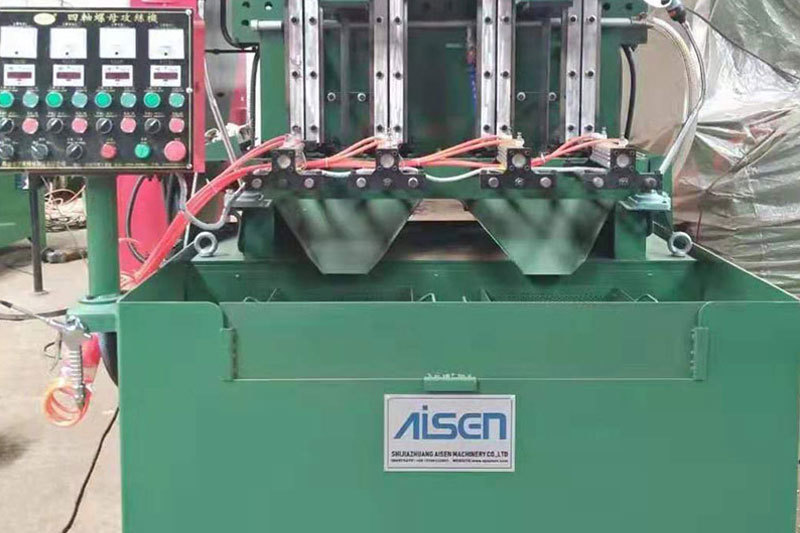
AISEN Four axis nut tapping machine ready for shipment to Russia
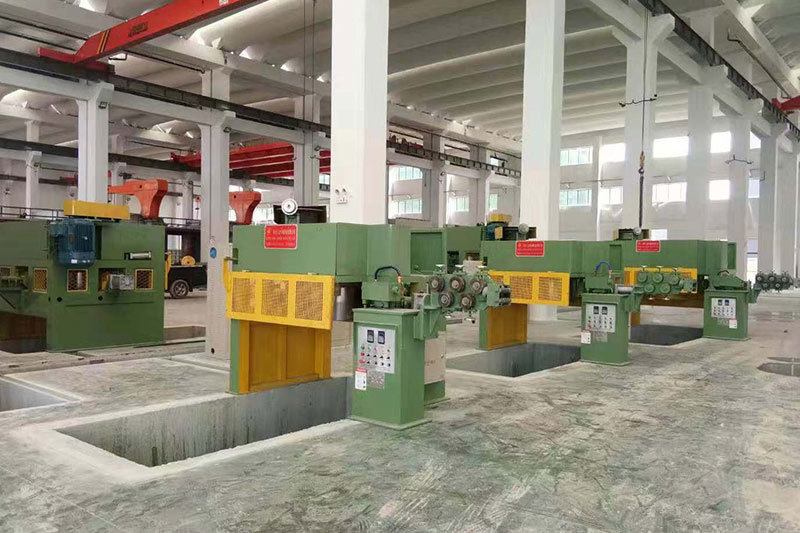
AISEN machinery inverted wire drawing machine
MESSAGES
We will contact you within one working day. Please pay attention to your email.
Qucik Link
Contact
Phone: +86-15100123091
E-mail: info@sjzaisen.com
Address: No.41 Zhaiying South Street, Yuhua District, Shijiazhuang City, Hebei Province China